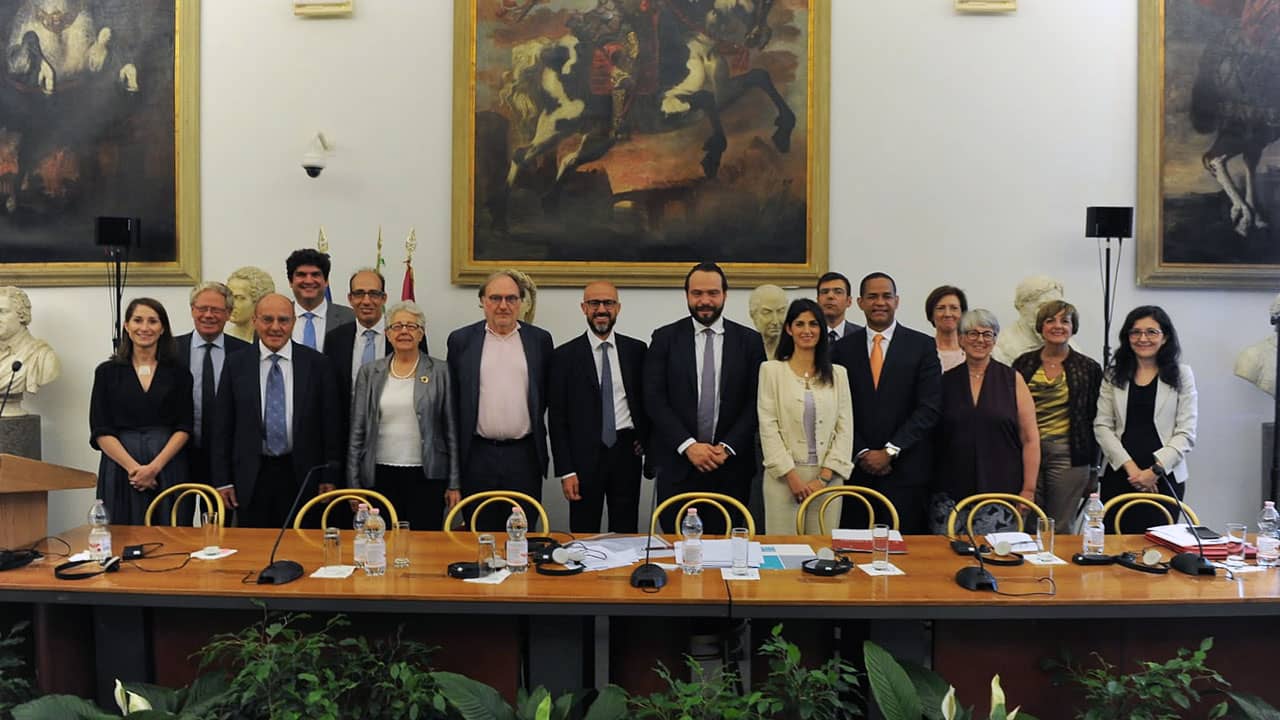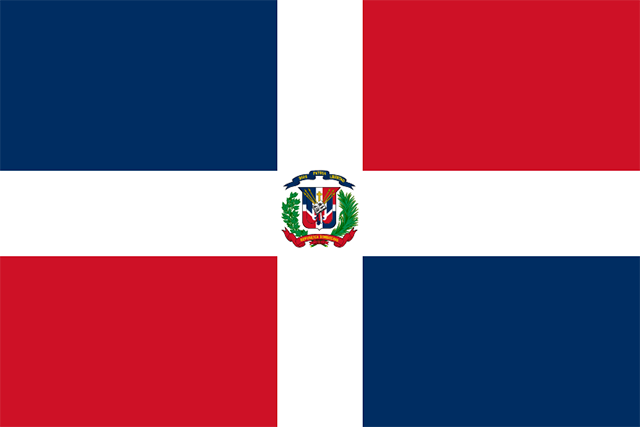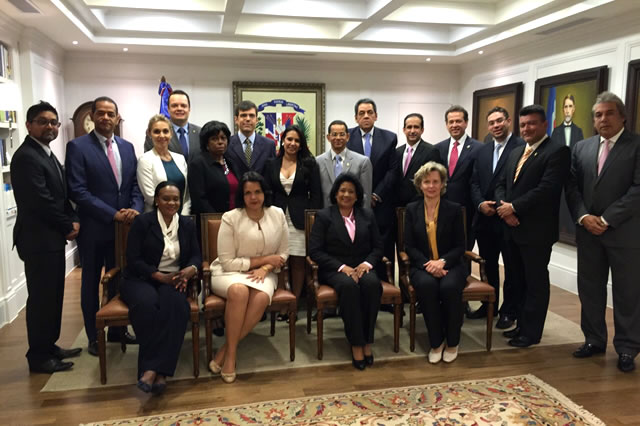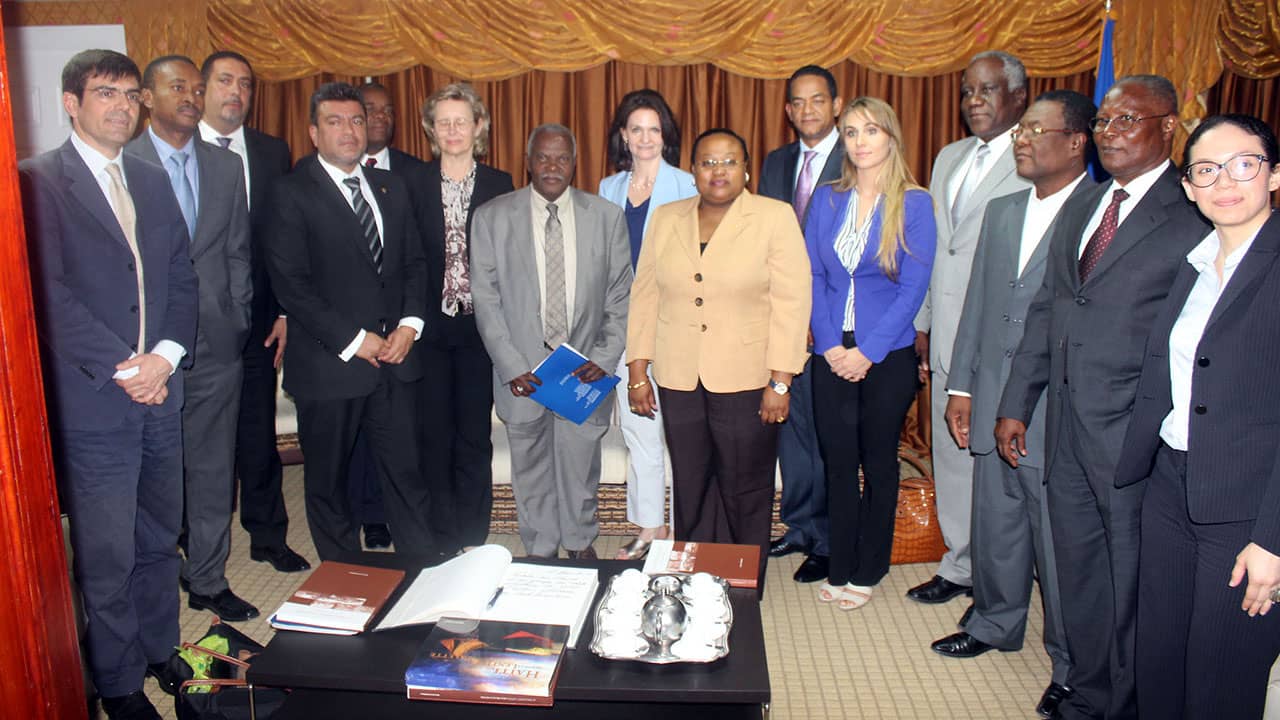



PGA has a long and solid partnership history with the Dominican Republic, a state party to the Rome Statute, of promoting the fight against impunity for the most serious crimes of international concern. On 6 December, 2014 the President of PGA was unanimously elected: Dip. Minou Tavárez Mirabal, from Dominican Republic. Currently PGA’s work focuses on the full implementation of the Rome Statute and strengthening the cooperation with the Court as well as the promotion of the Ratification of the Kampala Amendments.
Rome Statute
Dominican Republic representatives attended the Rome Conference and signed the Rome Statute on 8 September 2000. Its instrument of ratification was deposited on 12 May 2005.
Kampala Amendments of 2010
The Dominican Republic has not yet ratified the Kampala Amendments to the Rome Statute, but concrete steps have been taken. Indeed, the Kampala Amendments were incorporated in the new Criminal Code awaiting for its entry into force. The Crime of Aggression is defined in article 378 and the employment of poison or poisoned weapons; toxic or prohibited gases, liquids, materials or devices; and of prohibited weapons or bullets during times of both, non-international and international armed conflict in article 92 sections 25, 26 and 27.
For more information, please read this document.
Status on the domestic implementation of the Rome Statute
On 18 November, 2014, after Senate´s approval, the Chamber of Deputies of Dominican Republic approved the Criminal Code´s reform. Articles 89 through 95 enshrine provisions referring to genocide, war crimes, crimes against humanity, command responsibility and their respective penalties and status of limitation. The bill is the result of a 10 year criminal code reform process in Dominican Republic.
Previously, in the Plan of Action of the Assembly of States Parties for Achieving Universality and Full implementation of the Rome Statute of the International Criminal Court, 2009, the government of Dominican Republic recognized the importance of implementing the provisions of the Rome Statute by acknowledging the project for the new Criminal Code.
Moreover, the Constitution of 2008 incorporates general principles of law as per the Rome Statute, including non-applicability of statutes of limitation for several crimes including crimes against humanity, genocide and aggression.
Additionally, in regards to the establishment of cooperation mechanisms with the Court; on 4 and 5 December, 2014, in the context of the 8th Consultative Assembly for Parliamentarians for the ICC and the Rule of Law, PGA Members committed to the submission of a Bill to allow full cooperation of Dominican Republic with the ICC.
Agreement on Privileges and Immunities of the Court (APIC)
The Dominican Republic ratified the APIC on 10 September 2009.
Additional Agreements
A Bilateral Immunity Agreement with the US regarding the surrender of persons to the ICC was signed at Santo Domingo-September 13th 2002 which entered into force August 12th 2004.
progress in action
Genocide, crimes against humanity and general principles of International Criminal Law have been inserted in the Penal Code of 2006 thanks to the leadership and committment of several PGA Members led by Dip. Minou Tavárez Mirabal and Dip. José Ricardo Taveras.
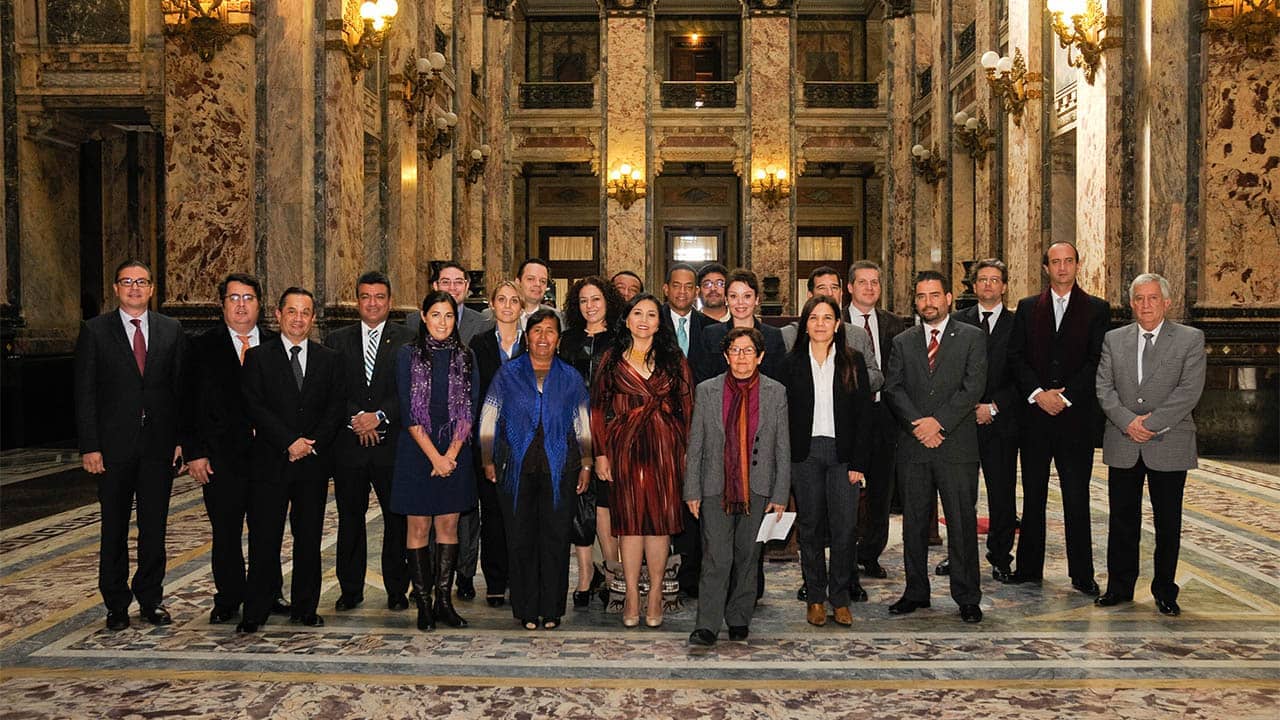
On 9 September 2011, PGA Board Member Dip. Minou Tavárez Mirabal (majority) and International Council Member Dip. Victor Bisono (opposition) organized a Round-Table attended by 10 parliamentarians, including those most involved in the drafting and adoption of the new Penal Code, in which PGA members included the crimes contained in the Rome Statute. The meeting sought to brief the PGA members on the developments at the ICC and the pending tasks in the Dominican Republic with respect to the Rome Statute. In concrete terms, this Round-Table aimed to provide techinical assistance to promote mainly (i) preparation and adoption of national implementing legislation on cooperation with the ICC; and (ii) ratification of the Kampala Review Conference amendments on crime of aggression and war crimes (iii) consideration of nominations of competent Judges, exploring all the possibilities given by the Rome Statute, with emphasis on the gender criteria.
As a result from the meeting with Parliamentarians, the MPs requested the PGA secretariat to provide technical input on the Criminal Code to the legal advisor of their Special Committee, including proposals that the PGA expert-staff presented on the definitions of crimes against humanity, war crimes and the crime of aggression.
Additionally, MPs agreed to present a resolution calling the government to transmit the Kampala Review Conference amendments to Parliament for ratification.
Therefore, following this meeting, PGA provided further input to add to the Criminal Code i.e. the definition of crime of aggression, inclusion of forbiden weapons for non-international armed conflicts and ensuring the insertions of general principles of law such as command responsibility, universal jurisdiction and the obligation aut dedere aut judicare. The amendments were submitted on 4 October 2011.
In the context of this Round-Table PGA staff also highlighted the period of nominations for the election of judicial officials at the ICC and the urgency of counting with enough Latin American candidates to meet the minimum voting requirements and proceed with the election at the ASP in December 2011
On 12 September, 2011, the PGA delegation accompanied by PGA members met at the Ministry for Foreign Affairs (a Vice-Minister, the Head of Multilateral relations and the Dominican Judge to the Inter-American Court for Human Rights) to follow-up on the urgency of a judicial nomination and on all other matters pertaining to the Executive, including the transmittal to the Parliament of the Kampala Amendments.
Dip. Minou Tavárez took the initiative in the procedure endorsed by all political parties that led to the prompt national nomination of a female candidate for Judge at the ICC – a national Judge who had 29 years of experience in criminal court cases as Presiding Judge of the Penal Chamber of the Court of Appeals and of the Penal Court of Santo Domingo.
Judge Herrera Carbuccia received the approval of the Assembly of States Parties and was elected on 11 March 2012, Judge at the ICC.
In the context of that mission, PGA also facilitated a meeting between the members of the Committee in charge of the revision of the Criminal Code amendment project, with the ICRC in November 2011. The concerns of the ICRC, however, were already incorporated in PGA's commentaries.
Organization of American States (OAS)
As a member of the Organization of American States, Dominican Republic has supported the promotion of the International Criminal Court through the adoption of an annual resolution by the General Assembly of the OAS, as well as by the holding of a working meeting of high level within the Political and Juridical Affairs Committee of the OAS. PGA members have been invited at numerous occasions to this meeting. For more information on the work of PGA within the OAS, click here.
African, Caribbean and Pacific community (ACP)
As a member of the African, Caribbean and Pacific community (ACP), and as signatory of the revised Cotonou Agreement of the ACP and European Union, Dominican Republic has recognized the importance of the ICC as a mechanism for peace and international justice, and has committed to promote the ratification and implementation of the Rome Statute, to seek to take steps towards the implementation of the Rome Statute, and to fight against international crime giving due regard to the Rome Statute regulations. For more information on the work of PGA within the ACP-EU mechanism, click here.
Human Rights Council Universal Periodic Review
Dominican Republic has been reviewed during the 18th session of the UPR in 2014. In the second cycle review the Dominican Republic received a recommendation regarding the ratification of the Kampala Amendments to the Rome Statute by Estonia. During the first cycle review in 2009 no recommendations regarding the Rome Statute had been made.
Related activities
- Parliamentary Workshop on the Ratification and Implementation of the Rome Statute and the Kampala Amendments in Dominican Republic 10 - 11 March, 2015, Santo Domingo, Dominican Republic
- Eighth session of the Consultative Assembly of Parliamentarians for the ICC and the Rule of Law, 2014, Rabat, Morocco
- Experts Sessions on the Rome Statute to clarify issues regarding the Rome Statute ratification and national implementation, 2014, San Salvador, El Salvador
- Sub-Regional Working Group on Challenges for the Effectiveness of the Rome Statute system in the Americas, 2014, Montevideo, Uruguay
- 35th Annual Parliamentary Forum, 2013, Bogotá, Colombia
- Sub-Regional Working Group on Challenges for the Effectiveness of the Rome Statute system in the Americas, 2013, Montevideo, Uruguay
- Seventh session of the Consultative Assembly of Parliamentarians for the ICC and the Rule of Law, 2012, Rome, Italy
- Mission to Central America –Ratification of the Rome Statute by El Salvador and Technical Assistance on Implementing Legislation by Dominican Rep. and Panama, San Salvador Panama City and Santo Domingo, 5-7September 2011
- Round Table on Implementing Legislation of The Rome Statute of the ICC, 2011, Santo Domingo, República Dominicana
- Parliamentary Delegation to the 10th Session of the Assembly of States Parties to the ICC, 12-21 December 2011, United Nations, New York
- Strategic Consultations on the role of International Organisations in Enhancing Law Enforcement and State Cooperation with the International Criminal Court - side event to the
- ICC Assembly of States Parties, 16 December 2011, United Nations, New York
- Participation of PGA Members and their official delegations attending the 20th session of the Africa-Caribbean-Pacific – European Union Joint Parliamentary Assembly (ACP-EU JAP), 2-5 Dececember 2010, Parliament of the DRC
- Fifth session of the Consultative Assembly of Parliamentarians for the ICC and the Rule of Law, 2008, Santo Domingo, Dominican Republic
- Regional Parliamentary Meeting on Ratification of the Rome Statute, 6 - 7 June 2008, Paramaribo, Suriname
- Participation of PGA Delegation to 15th Africa-Caribbean-Pacific-European Union Joint Parliamentary Assembly (ACP-EU JAP), 17 - 20 March 2008, Ljubljana, Slovenia
- Round-Table Discussion on the Fight against Impunity and the Access of Victims to Justice (ACP-EU JAP), November 2007, Kigali, Rwanda
- Regional Seminar for Parliamentarians on the ICC with focus on gender justice, 21 - 22 March 2007, Santiago, Chile
- Fourth session of the Consultative Assembly of Parliamentarians for the ICC and the Rule of Law, 2006, Tokyo, Japan
- PGA session on the ICC, COPA Meeting, 7 - 10 May 2005, Foz do Iguacu, Brazil
- Regional Conference on Implementation and Ratification, 16 - 17 March 2006, Mexico City, Mexico
- PARLIAMENTARY GROUP WELCOMES KENYA’S RATIFICATION OF THE INTERNATIONAL CRIMINAL COURT (ICC) STATUTE Kenya is 98th ICC State Party, Dominican Republic expected to become 99th, 15 March 2005
- Third session of the Consultative Assembly of Parliamentarians for the ICC and the Rule of Law, 2004, Wellington, New Zealand
- Ibero-American and Lusophone Conference on the International Criminal Court, March 2004, Brasilia, Brazil
- Second session of the Consultative Assembly of Parliamentarians for the ICC and the Rule of Law, 2003, New York, United States of America
- "International Conference on ICC Ratification and Implementation", 27-28 June 2002, Madrid, Spain