


Loading...

African, Caribbean and Pacific-European Union Joint Parliamentary Assembly

The ACP-EU Joint Parliamentary Assembly has been, since the establishment of the International Criminal Court, a forum for political support to the recognition of the important development for peace and international justice.

What is the ACP-EU JPA?

The ACP–EU Joint Parliamentary Assembly was created to bring together the elected representatives of the European Union (the members of the European Parliament) and the elected representatives of the African, Caribbean and Pacific states ("ACP countries") that have signed the Cotonou Agreement. A substantial part of the work of the JPA is directed towards promoting human rights and democracy and the common values of humanity, and this has produced joint commitments undertaken within the framework of the UN conferences.

The ACP-EU institutional legal framework supports the universality and effectiveness of the Rome Statute system to end impunity for the most serious international crimes since 2003, thanks to the leadership initiative of PGA members from ACP countries and the EU. In the revised Cotonou Agreement of 2005 and 2010, ACP and EU States reflected this determined position of Parliamentarians in the Preamble and at Article 11.7, which entails the commitment to fight impunity for mass atrocity crimes through the ratification and implementation of the Rome Statute of the ICC.

PGA’s Work

  • At the ACP-EU JPA session held in Ljubljana, Slovenia, in 2008, the ICC Office of the Prosecutor and the Director of PGA’s Campaign for the Rome Statute of the ICC addressed the plenary. After an intense debate on the ICC, the Co-Chair of the ACP-EU JPA, Mr. Wilkie Rasmussen MP (Cook Islands), announced that he was fully supporting to ICC and that his country would have soon ratified the Rome Statute. The Cook Island did in fact accede to the Rome Statute six months after the ACP-EU JPA plenary, following parliamentary approval of an ICC Ratification Bill.
  • In 2016, PGA provided legislative drafting assistance to Tonga, whose Prime Minister is a former Member of PGA, H.E. Mr. Tohiva, the recipient of the 2013 PGA’s Defender of Democracy Award.
  • In September 2017, the ICC President attended and addressed the Pacific Island Forum meeting of Heads of States held in Apia, Samoa. Leaders of Pacific Island States welcomed the ICC President’s intervention in their summit. In bilateral meetings at least three high-level delegations of Pacific States that have not yet joined the ICC – Kiribati, Solomon Islands and Tuvalu – committed to advance and complete the relevant ratification process. PGA assisted the ICC Presidency in providing technical assistance on domestic ratification and implementation legislation to Kiribati and Solomon Islands.
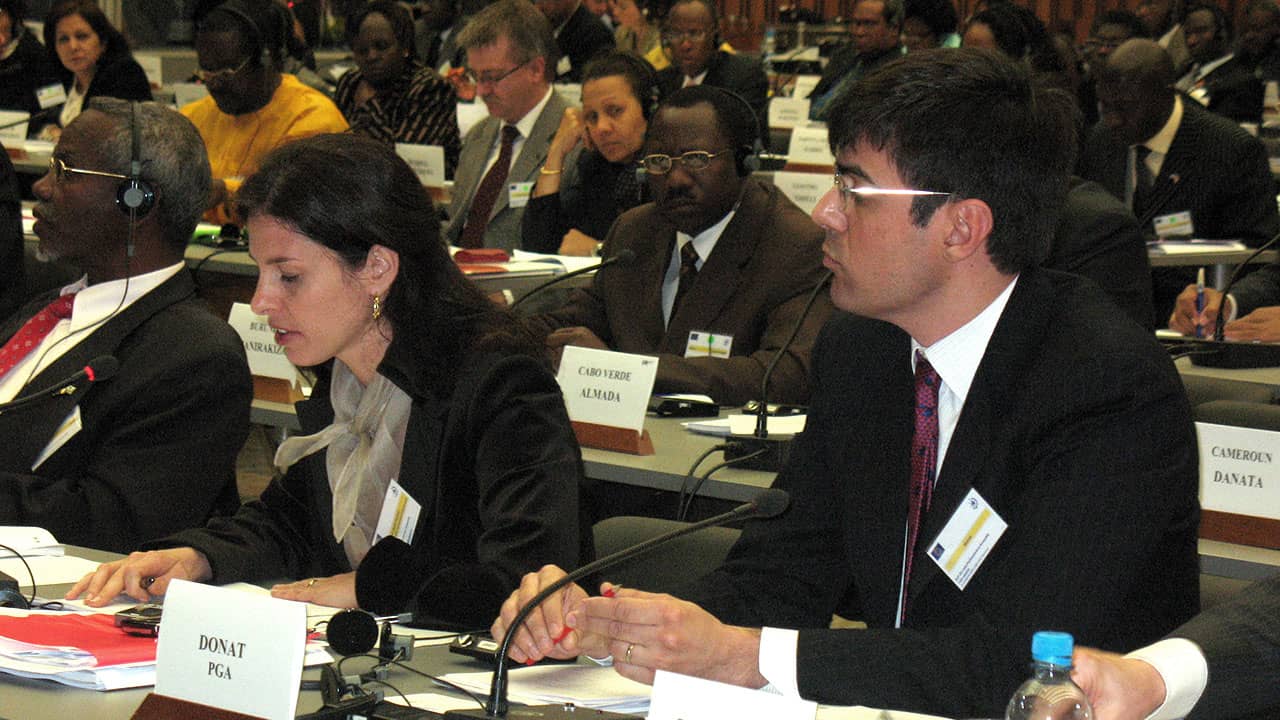
  • In June 2018, PGA organized an Interactive Luncheon Panel Discussion on the 20th Anniversary of the Rome Statute of the International Criminal Court (ICC): Expanding ICC Membership amongst the Pacific Island States at the European Parliament. The luncheon served to promote the universality and full implementation of the Rome Statute of the ICC amongst the Pacific Island States through the leadership efforts of parliamentary delegations attending the 35th ACP-EU JPA.  During the luncheon, the representatives from Government and Parliament of six Pacific islands countries (the Cook Islands, Republic of Fiji, Samoa, Solomon Islands, Vanuatu, Federated States of Micronesia) discussed the legal and political aspects, as well as obstacles hindering the advancement of the universality and full implementation of the Rome Statute.
  • Following the discussion, the Ambassador of Vanuatu to the EU has shown interest in advancing the implementation process in his country. At his request, PGA prepared a draft law on implementing Rome Statute (incorporating all Amendments to the Rome Statute and all four cooperation agreements with the ICC) and submitted it to the Ambassador who forwarded the documents to the relevant domestic authorities.
  • Upon the invitation of the Ambassador of Vanuatu to the EU, extended as a result of engaged cooperation followed by the 2018 luncheon, PGA organized jointly with the ICC and the Republic of Korea the Pacific Islands Roundtable on the ratification and implementation of the Rome Statute of the ICC on 31 May 2019 in Port Vila, Vanuatu.
  • Two weeks after the Roundtable, the Cabinet of Kiribati approved the decision to accede to the Rome Statute. PGA sent a tailored model instrument of accession to the Minister of Justice in June and October 2019, which was formally deposited by the Permanent Representative of Kiribati to the UN in November 2019, making Kiribati the 123rd State Party to the Rome Statute of the ICC.
Status of the Rome Statute System as of October 2024:

 
States that have ratified the Rome Statute [125]
 
States that have signed the Rome Statute but have not ratified it yet [29]
 
States that have withdrawn from the Rome Statute [2]
 
States that have neither signed nor ratified the Rome Statute
 

125 countries are States Parties to the Rome Statute of the International Criminal Court. Of these, 33 are African States, 19 are Asia-Pacific States, 20 are from Eastern Europe, 28 are from Latin American and Caribbean States, and 25 are from Western European and other States.

Work of PGA in this Country:

Publication

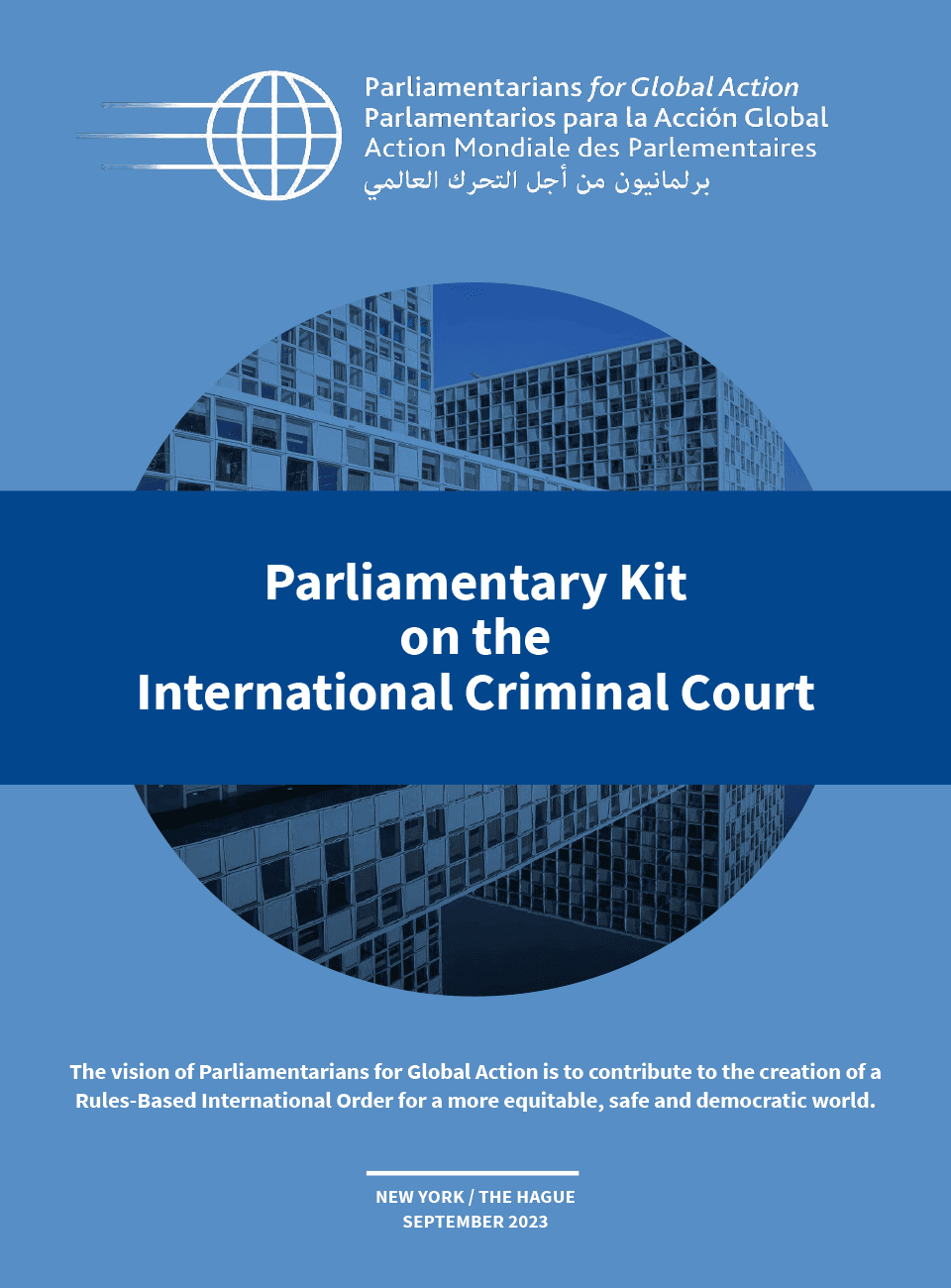
Parliamentary Kit on the International Criminal Court

Parliamentary Kit on the International Criminal Court

It is imperative that the Rome Statute be ratified universally for the successful functioning of the Court. Parliamentarians should ensure that the ICC is truly universal.

Description

Created by the Rome Statute, the International Criminal Court (ICC) is the first permanent and independent international court capable of investigating and bringing to justice individuals who commit the most serious violations of international criminal law, international humanitarian law, and human rights.

The Rome Statute defines the crimes under the Court’s jurisdiction and provides the general principles and procedures for the operation of the Court. It also outlines the cooperation obligations of its State Parties. It is imperative that the Rome Statute be ratified universally for the successful functioning of the Court. Parliamentarians should ensure that the ICC is truly universal.

PDF(s)

Additional Details

  • Publication Type: Toolkit
  • Author(s): Parliamentarians for Global Action

Publication

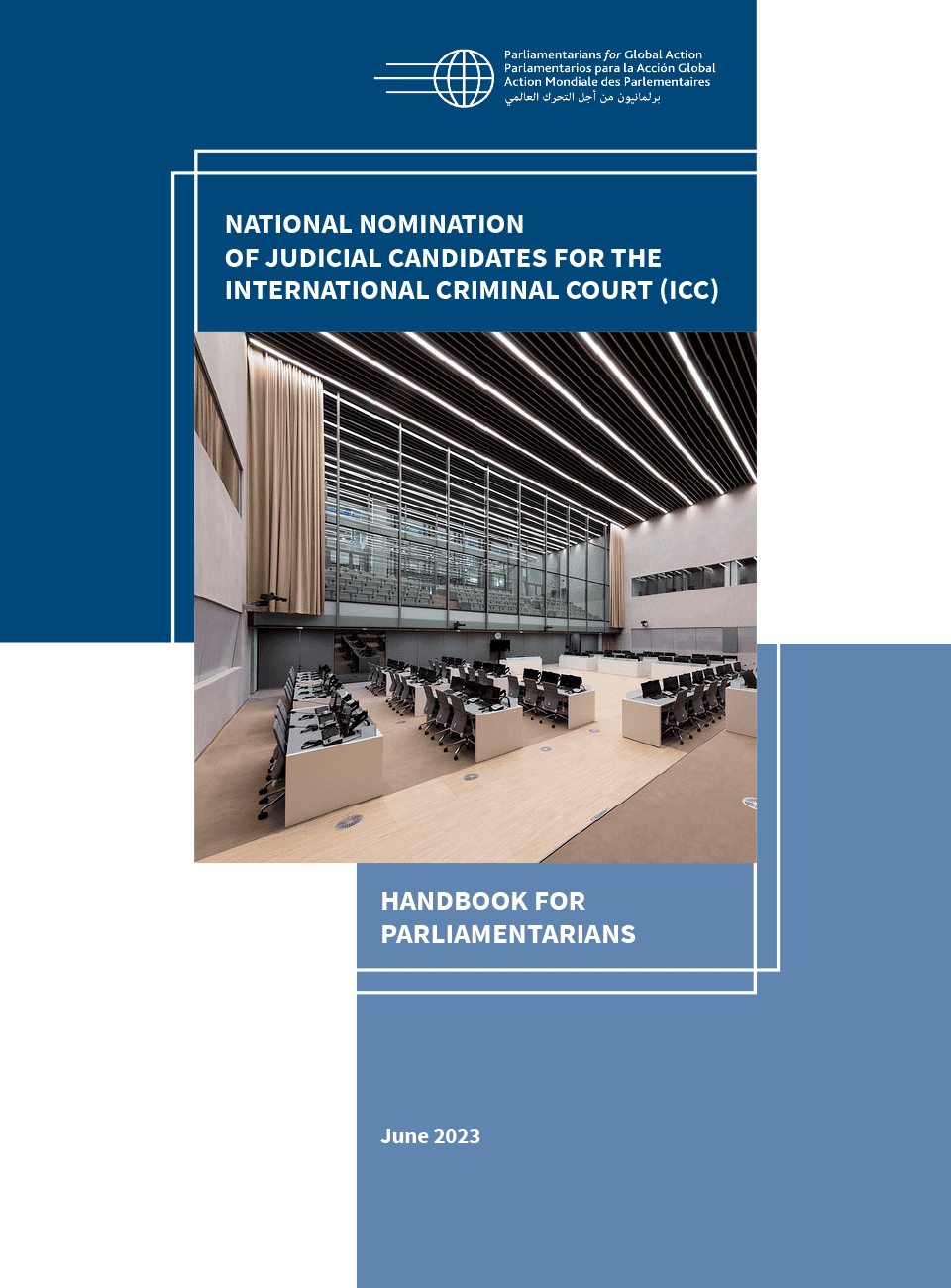
National Nomination of Judicial Candidates for the International Criminal Court

National Nomination of Judicial Candidates for the International Criminal Court

Criteria and recommendations for parliamentarians to improve national nomination procedures for International Criminal Court judicial candidates.

Description

The ICC is the first and only permanent independent court with the mandate to investigate and prosecute individuals responsible for committing international crimes, namely genocide, crimes against humanity, war crimes, and the crime of aggression. Its 18 judges from around the world, elected for a nine-year term, play a key role in ensuring this expectation is lived up to through their primary mandate to render authoritative and high-quality jurisprudence and guarantee fair trials.

Therefore, the quality of the judges has fundamental importance to the performance, efficiency, and effectiveness of the ICC, which is at the heart of the long-term success of the ICC and the Rome Statute system as a whole. In this handbook, PGA sets forth specific criteria and recommendations for Parliamentarians to encourage their governments to improve national nomination procedures for ICC judicial candidates and adopt good practices and requirements to ensure these processes are fair, transparent, and merit-based. The goal of robust nomination procedures is to ensure that only candidate judges or jurists of the highest caliber make it on the ballot.

PDF(s)

Additional Details

  • Publication Type: Handbook
  • Author(s): Parliamentarians for Global Action

Publication

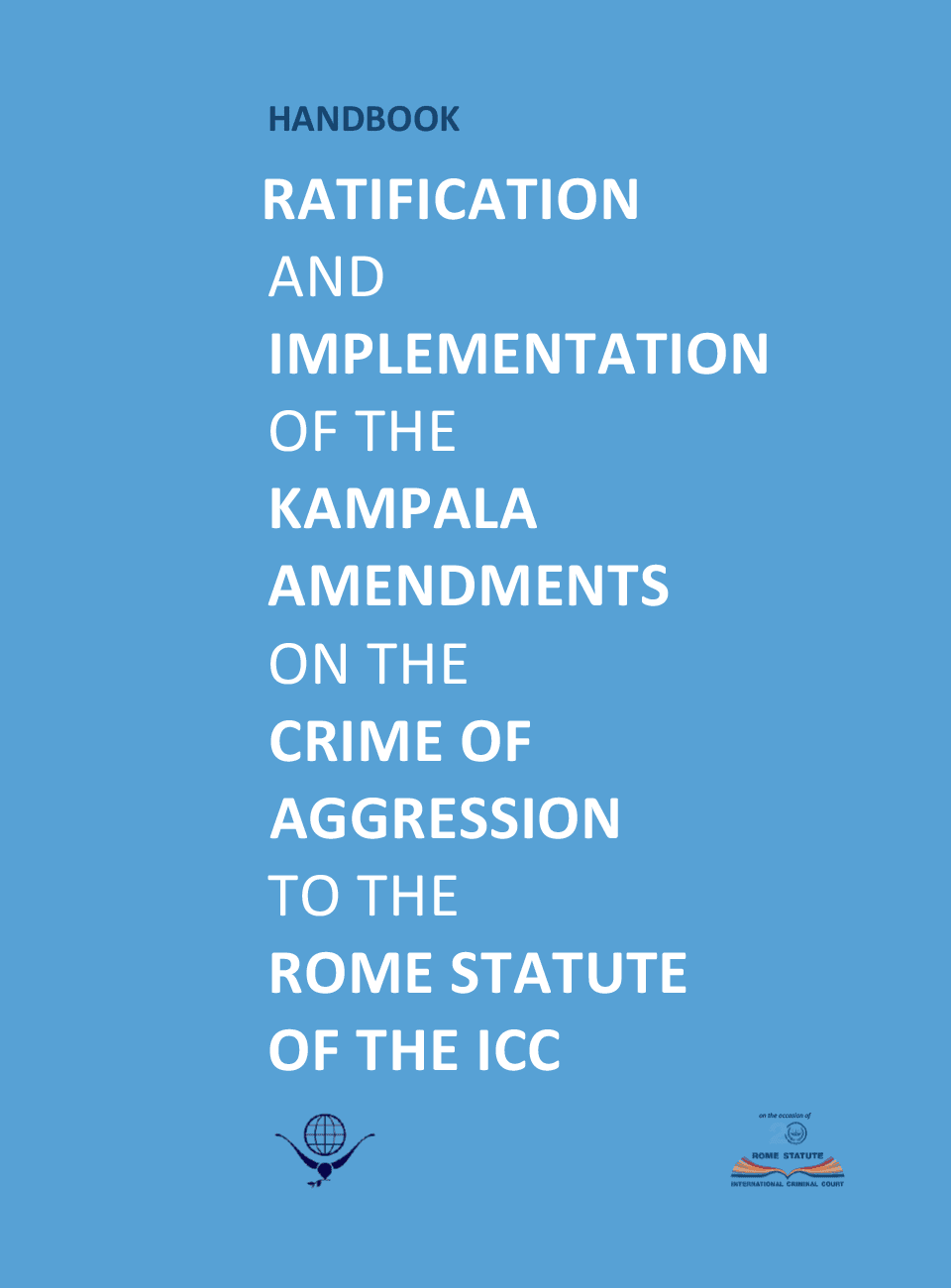
Ratification and Implementation of the Kampala Amendments on the Crime of Aggression to the Rome Statute of the International Criminal Court

Ratification and Implementation of the Kampala Amendments on the Crime of Aggression to the Rome Statute of the International Criminal Court

A handbook aimed at assisting States in ratifying the Kampala Amendments, helping criminalize the most serious forms of the illegal use of force.

Description

It is our honor and privilege to present to you the Third Edition of the Handbook on the Ratification and Implementation of the Kampala Amendments on the Crime of Aggression to the Rome Statute of the ICC.

It is the product of our collaborative effort aimed at assisting States in ratifying the amendments adopted by consensus in Kampala and helping criminalize the most serious forms of the illegal use of force.

PDF(s)

Additional Details

  • Publication Type: Handbook
  • Author(s): Permanent Mission of the Principality of Liechtenstein to the United Nations; Global Institute for the Prevention of Aggression; Liechtenstein Institute on Self-Determination at Princeton University (LISD); (Drafting Assistance by PGA)