


In cooperation with The Harvard Law School (HLS) Advocates for Human Rights clinical program, the PGA Secretariat, represented by Dr. David Donat Cattin (PGA Secretary General) and Ms. Frederika Schweighoferova (Director, Rome Statute Campaign), has taken part in a project aimed at increasing the efficiency and legitimacy of the International Criminal Court (ICC): Expanding the Jurisdiction of the International Criminal Court: Articles by Parliamentarians for Global Action in Cooperation with HLS Advocates for Human Rights
The project aims at identifying and analyzing areas for the progressive development of International Criminal Law and, in particular, potential amendments to the Rome Statute in order to:
- create hybrid chamber(s) within the Court, with the proposed addition of national judges from situation-countries,
- expand the Court’s jurisdiction to appropriately address the cries of ecocide and trafficking in human beings, and
- expand its personal jurisdiction to hold corporations liable under criminal liability. This project also suggests ways in which the current statutory framework of the ICC could be used to tackle the above-mentioned challenges.
Benefitting from the research provided by HLS Advocates, PGA Secretariat and international experts have produced a “white paper”, which consists of six separate reports that analyze the topics which have been at the focus of the project. This document lays the foundation for a coalition of States parties and civil society to advance the innovative ideas presented in each individual report and, eventually, to amend the Rome Statute from both substantive and institutional perspectives (any amendment to the Rome Statute is relatively easier for proposals of institutional character). These reports have been also been published in the form of shorter online articles/blogs published by the Harvard International Law Journal.
On behalf of PGA, Dr. Donat Cattin and Ms. Schweighoferova have (co-) authored three reports and blogs:
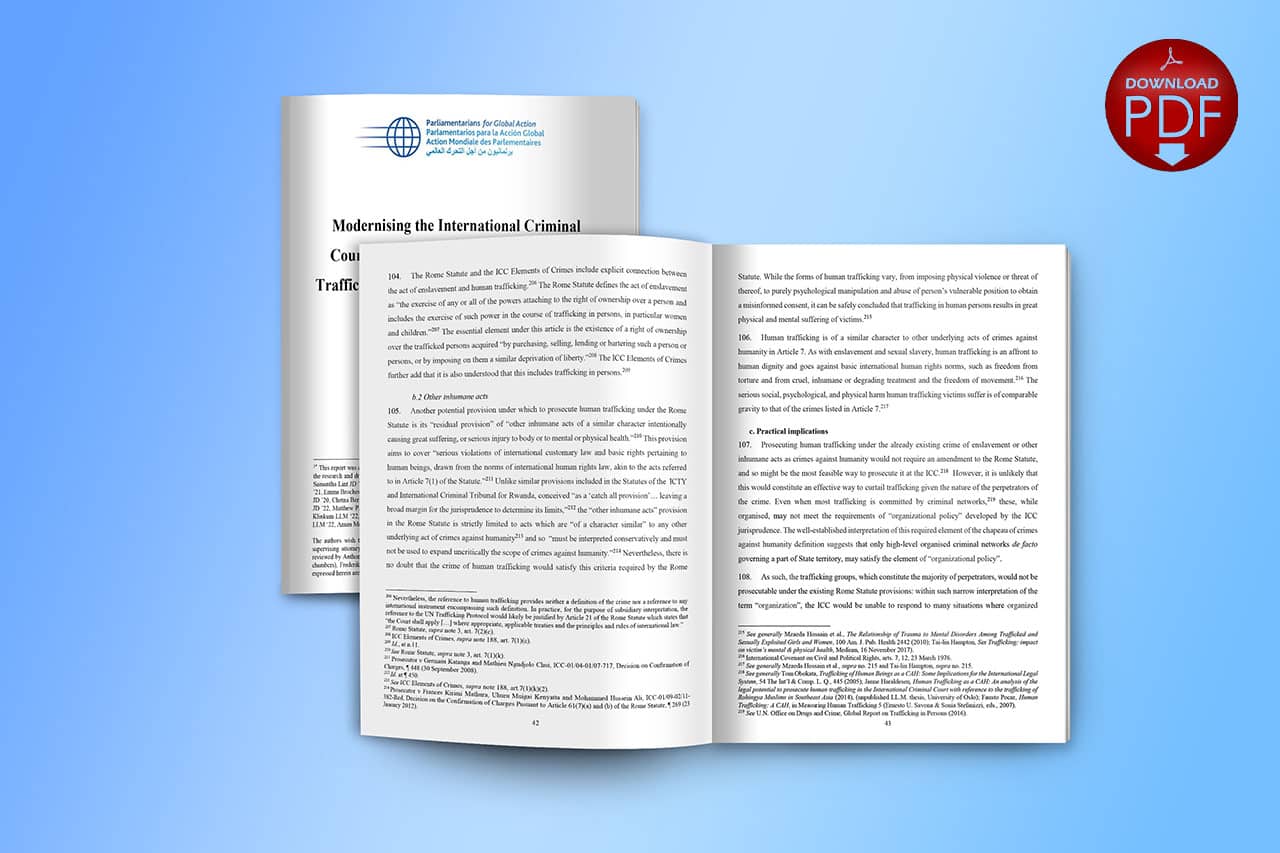
- Modernising the International Criminal Court: Crimes against the Environment,Trafficking in Human Beings, Hybrid Justice and Corporate Accountability
- Making the Case for a Hybrid Chamber at the ICC;
- Taking Down One of the World’s Largest and More Profitable Criminal Industries: Trafficking in Persons - Part I, co-authored with former Legal Advisor of PGA, Ms. Romina Morello
- Taking Down One of the World’s Largest and More Profitable Criminal Industries: Trafficking in Persons - Part II: Libya and Central America
The list of all blogs published under the project:
-
Making the Case for a Hybrid Chamber at the ICC (David Donat Cattin & Philippa Greer)
-
Taking Down One of the World’s Largest and More Profitable Criminal Industries: Trafficking in Persons (Part I) (Romina Morello & Frederika Schweighoferova)
-
Taking Down One of the World’s Largest and More Profitable Criminal Industries: Trafficking in Persons (Part II: Libya and Central America) (Frederika Schweighoferova)
-
ICC Personal Jurisdiction on Corporations for Criminal Liability and/or Civil Liability for Reparations (Juan Pablo Calderón Meza)
-
If the Shoe Fits, Wear it (and Codify It as a Crime Against the Environment) (Anthony Abato)
-
Ecocide Law: The Use of Hard Law to Complement Soft Law (Shirleen Chin)
Publication
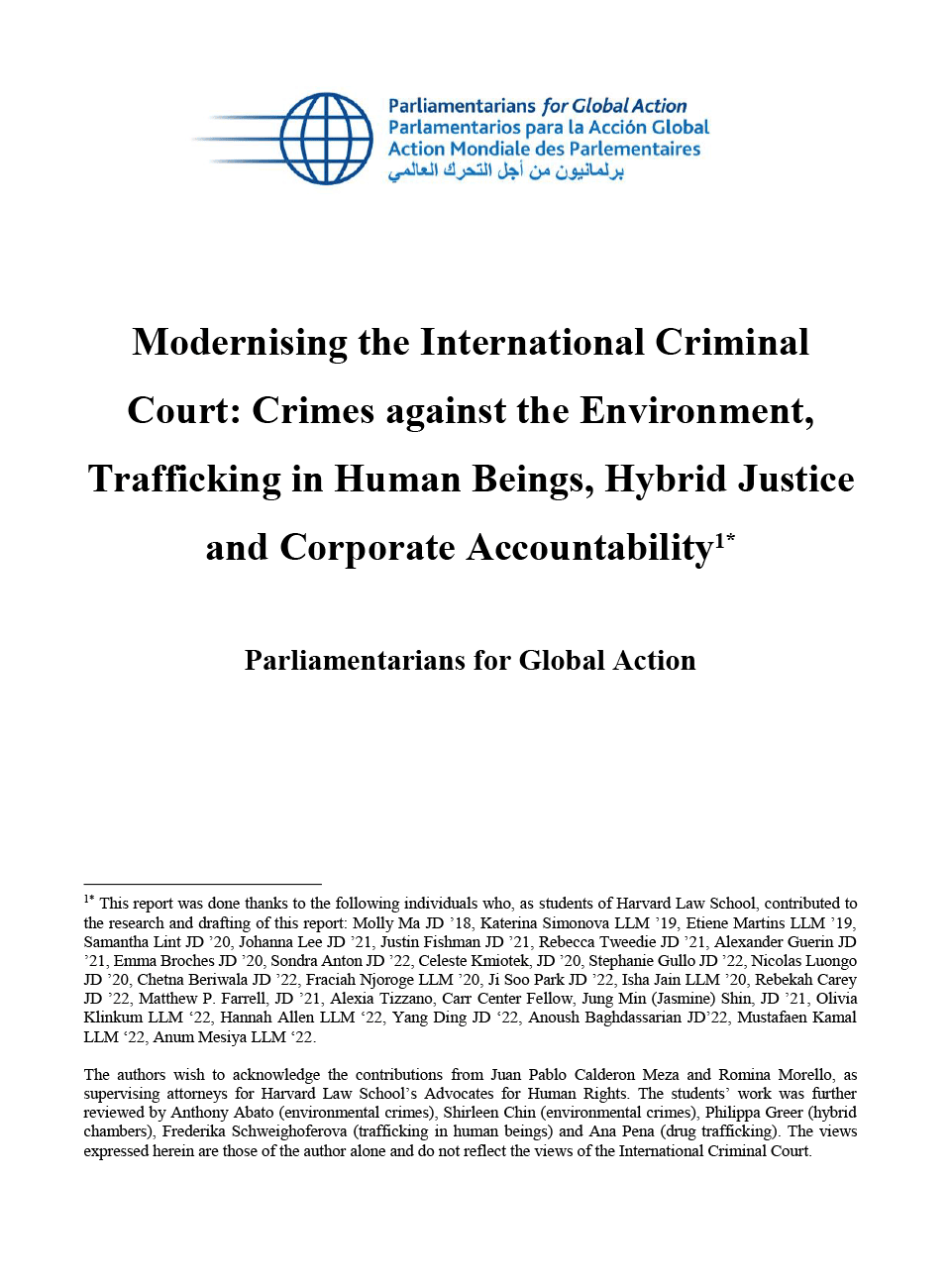
Moderniser la Cour pénale internationale : crimes contre l’environnement, traite des êtres humains, justice hybride et responsabilité des entreprises
(disponible en anglais)
Description
The International Criminal Court (ICC or Court) must evolve to enhance its legitimacy, efficacy, and ability to tackle the challenges of today’s world. Besides war crimes, genocide, crimes against humanity, and the crime of aggression, we face further atrocities in times of peace due to the environmental and migration crisis, which is closely intertwined with human trafficking; abuses perpetrated and facilitated by corporate actors- that cannot be held to account for atrocities due to the ICC’s personal jurisdiction-; a lack of state cooperation with the ICC, also derived from the misperception of the ICC by certain States as foreign and hostile actor judging other States’ nationals.
PDF(s)
Additional Details
- Type de publication: White Paper
- Auteur.e.s: Parliamentarians for Global Action