

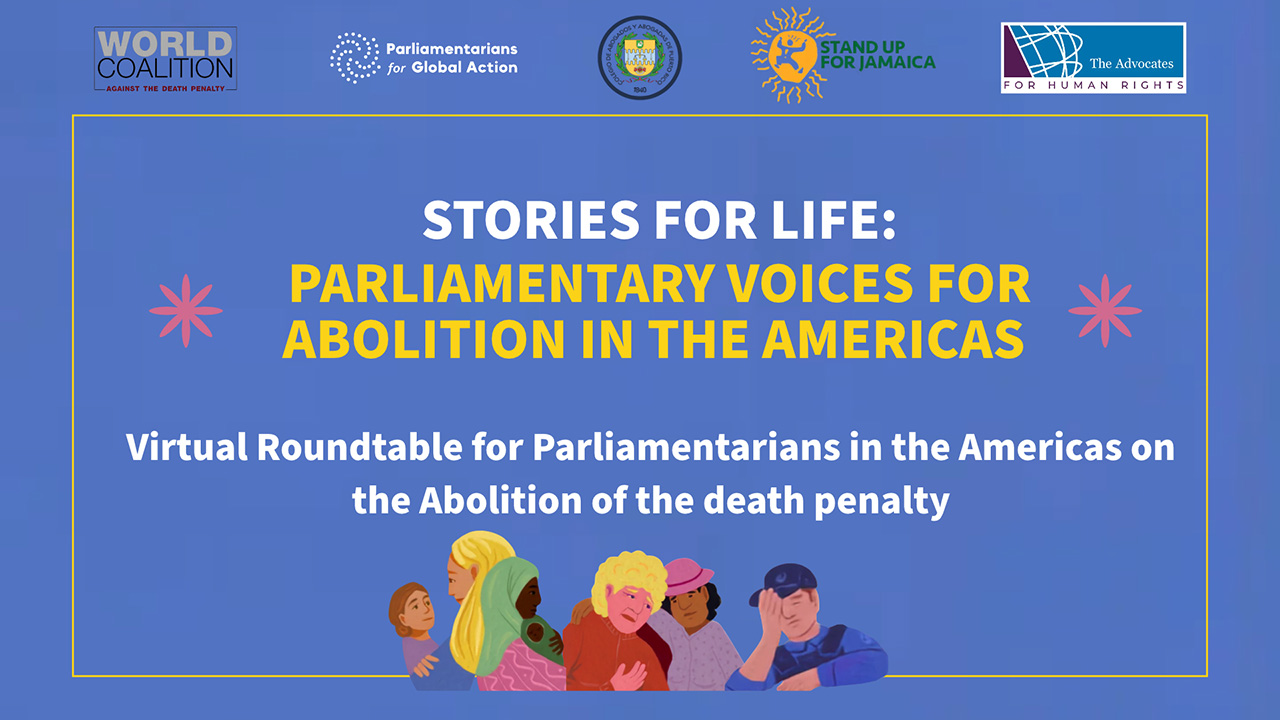
On 7 October, just three days before the World Day Against the Death Penalty, parliamentarians from across the Americas gathered for a virtual roundtable on the abolition of the death penalty, co-organized by Parliamentarians for Global Action, Stand Up For Jamaica, the Puerto Rico Bar Association (Colegio de Abogados y Abogadas de Puerto Rico), The Advocates for Human Rights, and the World Coalition Against the Death Penalty.
To highlight the theme “Stories for Life,” this event offered an opportunity for thirteen legislators from Antigua and Barbuda, Belize, Jamaica, Saint Lucia, Suriname and the USA, to hear directly from practitioners and experts, and reflect together about strategies at national and international levels to engage with their governments and constituents, with a view to advancing national reform efforts and promoting human rights for current and future generations.
“Behind every statistic is a human story”
In her welcoming remarks, Hon. Heatha Miller, MP (Jamaica), PGA Member, highlighted the importance of legislators’ engagement as representatives whose voices are capable of shaping public discourse. They, therefore, bear a special responsibility, including in keeping the issue of abolition on the legislative agenda. This World Day Against the Death Penalty reminds us that “behind every statistic is a human story,” expressing the hope that these testimonies can be placed at the center of the conversation to advance justice, dignity and protection of human life.
Participants heard from Ms. Talibah Byron-Chiverton, Attorney-at-Law and Notary Public at Byron & Byron, in Saint Kitts and Nevis, who shared her experience representing Mr. Evanson Mitcham, the last person held on death row in the country, where he spent sixteen years. She recalled her decision to take the case and the cruel treatment Mr. Evanson Mitcham experienced. “Everyone has the fundamental right to protection. If we do not believe in that, we do not believe in the rule of law,” she said. Terrible crimes can touch any community and will remain with it, but a terrible crime does not give the State the right to kill. The Judicial Committee of the Privy Council found that Mr. Mitcham’s rights had been violated in 2018, and overturned his death sentence. Thanks to her unwavering commitment, Mr. Evanson Mitcham was released in 2025.
Her powerful testimony resonated strongly with parliamentarians. Hon. Janelle Chanona, MP (Belize), a member of PGA Executive Committee, drew parallels to her own country’s context, reflecting about the unique dynamics of smaller countries and the realities behind retributive and revenge-driven forms of justice. She underlined the need to work towards alternatives. Hon. Valerie Woods, Speaker of the Parliament of Belize and PGA Member, noted the de facto moratorium in Belize, which is in place since the last execution in 1985. She argued it is now timely to have a robust debate about amending the law, so that it reflects the practice. Hon. Sheena Pitts, MP (Belize), PGA Member, added that legislators bear a greater responsibility to ensure they do not discriminate in their approach to justice. Parliamentarians also raised the case of Christa Pike in Tennessee, which has drawn international attention and underscored the cruelty of the death penalty. For Rep. Jack Patrick Lewis (USA), the fact that the case of Christa Pike made international news is both a source of sadness and a sense of empowerment: he noted that the cruelty she suffered received global media coverage and is now part of the conversation. He thus emphasized the importance of taking action at both the local and international levels.
Finally, Hon. Isaat Buchanan, MP (Jamaica), observed that Jamaica’s moratorium is also the result of international pressure aimed at upholding human rights. He stressed the need for further awareness raising and public education about the death penalty. He noted the issue of extrajudicial and unlawful killings by the police, the high rate of which is a matter of serious concern in the country.
Reflecting on avenues to abolish the death penalty
Suriname offered a compelling counter-example for the minority of States in the Americas that still retain the death penalty, often as a legacy of the colonial era. Hon. Ingrid Karta-Bink, MP (Suriname), shared the experience of her country, which removed the death penalty from the Penal Code in 2015 and from the Military Penal Code in 2021. She reported that on 23 July, the National Assembly took another significant step when all members present voted in favor of approving Suriname’s accession to the Second Optional Protocol to the International Covenant on Civil and Political Rights: “this unanimous vote carried an important message: on an issue concerning the fundamental value of human life, political differences need not prevent national consensus.” She further informed participants that Suriname’s authorities are planning to deposit the instrument of ratification soon.
In discussions about national avenues to abolish the death penalty and examples from other countries, it is equally important to understand what evidence says about public opinion, which is often used as a justification for retaining the death penalty. Ms. Connie Parker-Dhinakaran, Project Manager for The Death Penalty Project, presented findings from the study “Sentenced to death without execution: Why capital punishment has not yet been abolished in the Eastern Caribbean and Barbados.” The research revealed that, among respondents, only a minority (30%) felt strongly about retaining the death penalty and that retributive reasons mattered most to those who favored retention. Crucially, the results of the study found that if abolition is pursued, there will be no public backlash. The study highlights the need to dedicate spaces for constituents to have debates that are grounded in reality and data, based on real stories, and that include voices of persons with direct experience. There is the need for more education on the death penalty as a human rights issue, community conversations and reconciliation. “The issue requires government leadership,” she said, emphasizing that the results of the study show that abolition gains traction, even in places where status quo is maintained.
International levers for parliamentarians
Participants discussed avenues for parliamentarians to engage at the international level. This is notably the case of the Universal Periodic Review (UPR), a mechanism that can contribute to advancing abolition of the death penalty. Ms. Michelle Brathwaite, Regional Representative, Office of the United Nations High Commissioner for Human Rights (OHCHR), CARICOM Regional Office, reminded participants that the OHCHR opposes the death penalty in all circumstances. She stressed the need to address gaps between the law and former practice, and called for more nuanced public conversation that move beyond binary exchanges. Underlining the important role played by parliamentarians, she emphasized the necessity, for our societies to be safer, to address the effectiveness of criminal justice systems and public confidence in them. Such conversations can take place within the framework of the UPR, even when States are not yet ready to act and do not support recommendations made by their peers; indeed, this instrument can be treated to maintain an international benchmark and keep the issue of the death penalty on the national and international agendas. Mr. João Maya Cunha, Human Rights Officer, Office of the UN OHCHR, Caricom Office, reminded participants that the UPR mechanism has a concrete impact on the lives of the people and explained that parliamentarians can support it by:
- Reviewing and amending laws to align them with accepted UPR recommendations;
- Allocating resources for human rights priorities;
- Questioning relevant ministries, requesting reports and monitoring implementation;
- Engaging with National Human Rights Institutions, civil society, and affected communities.
Another important opportunity for global commitment, is the biennial United Nations General Assembly Resolution calling for a moratorium on the use of the death penalty. Ms. Chiara Sangiorgio, Death Penalty Advisor at Amnesty International, explained that this resolution carries political weight and draws a clear link between the promotion of human rights and the suspension of executions. With the Committee-level vote scheduled for November, and the final vote for December 2026, she encouraged parliamentarians to engage in the process and urge their countries to instruct Ambassadors in New York. She recommended parliamentarians support the process, in meeting with Cabinet members, participating in roundtables considering the resolution, presenting parliamentary resolutions, asking parliamentary questions, and pushing the conversation in regional fora, such as CARICOM.
Recommendations for action
Before presenting the recommendations concluding the event, Mr. Kevin Miguel Rivera, Second Vice-President and Chair of the Death Penalty Committee, Colegio de Abogados y Abogadas de Puerto Rico, noted that while Puerto Rico banned the death penalty in its Constitution in 1952, it remains a US territory where federal capital punishment can be applied, and new cases have emerged under the current administration.
In view of the urgency to do more for abolition of the death penalty, including in restating the fact that the death penalty is a human rights issue, Mr. Kevin Miguel Rivera called parliamentarians to:
- Listen to the people directly impacted by the death penalty. Their stories provide an understanding of the suffering endured by directly impacted persons, which amount to torture and other cruel, inhuman or degrading treatment. Their accounts shed light on the structural, social, and individual conditions that lead a person into a conflict with the law – conditions that must be addressed.
- Promote dialogue about justice and human rights with citizens, victims’ associations, civil society organizations, and other relevant stakeholders.
- In parliamentary debates and public discourse, highlight the risks of wrongful convictions, the proven lack of deterrence, and the discriminatory nature of capital punishment. Advocate for the need to dedicate resources to crime prevention that address root causes of violence.
- Collaborate with like-minded parliamentarians across party lines to identify legislative strategies for abolition and support or initiate legislative efforts that lead to abolition.
- Collaborate with parliamentarians from other countries, to learn from their experience in strengthening abolitionist efforts.
- Urge your government to support and vote in favor of the upcoming United Nations General Assembly Resolution for a Moratorium on the Use of the Death Penalty, scheduled to be adopted in December 2026, to signal a firm commitment to international human rights standards. PGA stands ready to support you.
- Engage in the Universal Periodic Review of your country and monitor the implementation of accepted recommendations or commitments taken by your government in relation to the abolition of the death penalty.
- Work hand-in-hand with civil society, including victims’ groups, to build a path towards abolition.
Hon. Heatha Miller, MP (Jamaica), closed the session by restating the need to move from a narrative based on fear and punishment to one grounded in accountability and dignity. “The experience shared today demonstrated that progress is possible when MPs are prepared to lead,” calling on participants to bring the conversation to their constituents, and ensuring that stories of persons directly affected by the death penalty are heard.