



How can legislators advance international justice? This was the question members of Parliamentarians for Global Action examined on 25 March 2026, on the sidelines of PGA's 46th Annual Forum in Mexico City.
Legislators have long driven progress on international justice, as evidenced by the concrete results achieved by PGA members who contributed to the ratification and domestic implementation of the Rome Statute and other achievements. However, the current fragility of international norms and the troubling rise of crises worldwide demand a strengthened commitment, including through parliamentary engagement. In this context, legislators from the Cook Islands, Guyana, Jamaica, the Netherlands, Nigeria, The Gambia, Ukraine, and Zimbabwe met to take stock of the current situation and to discuss strategies to prioritize the fight against impunity.
Rome Statute of the International Criminal Court: threats and opportunities
The International Criminal Court faces unprecedented challenges, including threats of withdrawal or withdrawal procedures that undermine the Court's universality. Many of these threats are fueled by persistent misconceptions about the Court's mandate, which legislators can dismantle through peer-to-peer dialogue and raising public awareness. As participants emphasized, the ratification of the Rome Statute is crucial to strengthening the rule of law at all levels, a fundamental criterion for democratic countries that must not be compromised in these challenging times.
125 countries are States Parties to the Rome Statute, while an additional 29 signatory States have yet to complete the ratification process, and others would need to accede to the treaty to achieve true universality. Jamaica, which signed the Statute in 2000, has not yet finalized ratification due to constitutional obstacles and external political pressures that have undermined political will. Hon. Dr. Angela Brown Burke, MP (Jamaica), illustrated how geopolitical shifts have offered new opportunities to revive dialogue: the consequences of global crises on Jamaican citizens (notably the situation of Jamaican students who were in Ukraine at the time of the Russian Federation's aggression) have highlighted the gravity and relevance of international justice, prompting the political opposition to support ratification and relaunch the debate at the national level. She stressed the need for parliamentarians and relevant stakeholders to seize this moment, which requires sustained public awareness.
In contrast, Ukraine's path to ratification offers an example of a lengthy but successful process. Hon. Dr. Galyna Mykhailiuk, MP (Ukraine), outlined to participants the parliamentary efforts undertaken over 24 years to overcome obstacles, which ultimately led to the Verkhovna Rada's adoption of the law ratifying the Rome Statute and its amendments in 2024. She emphasized, however, that ratification marks only the beginning: parliamentarians must now drive domestic implementation to ensure the treaty's effectiveness.
The need for implementation in national legislation resonated among participants. For Hon. Daniel Molokele, MP (Zimbabwe), the Ministry of Justice should adopt a plan of action to domesticate the Rome Statute and achieve its ratification. From the Gambian side, Hon. Abdoulie Ceesay and Fatoumatta Njai, MPs, underlined the importance of PGA's African Working Group Dialogue on International Justice and the International Criminal Court, organized in November 2025 in Nairobi, which exposed gaps in their current domestic legislation and prompted them to engage with their government and work on dedicated legislation.
To support smaller states that may lack capacity and to raise further awareness of the Rome Statute system, parliamentarians recommended strengthening ties with regional organizations, such as the Caribbean Community (CARICOM) and the African Union. Hon. Amanza Walton-Desir, MP (Guyana), noted that such regional assistance would be vital for navigating complex legal frameworks.
Participants discussed the upcoming election of six International Criminal Court judges, which will take place in December 2026 during the Assembly of States Parties to the Rome Statute. As Parliamentarians for Global Action has long advocated, the quality of judges is of fundamental importance to the performance, efficiency, and effectiveness of the International Criminal Court, which is at the heart of the long-term success of the Rome Statute system. Parliamentarians were therefore recommended to call on their government to establish fair, transparent, and merit-based national nomination procedures and monitor elections to ensure only the most highly qualified individuals are elected as ICC judges.
International justice opportunities
Efforts for accountability are multiplying, as demonstrated by the increasing number of cases brought before the International Criminal Court, the International Court of Justice, or under the principle of universal jurisdiction. Other initiatives are underway to address gaps in the international legal framework, and parliamentarians can play a crucial role in supporting such developments and ensuring their robust implementation:
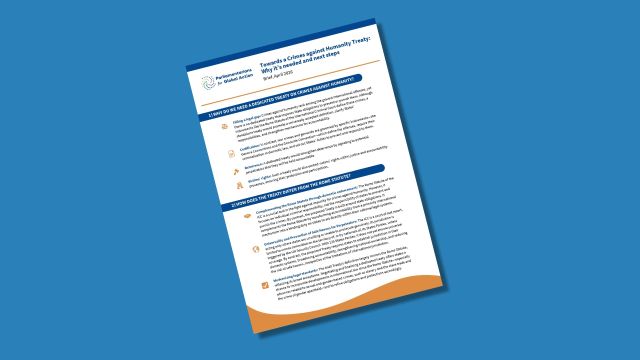
- Crimes against Humanity: The draft Convention on the Prevention and Punishment of Crimes Against Humanity, if adopted, will fill critical legal gaps and enhance victims' rights and protection. The draft Convention offers an opportunity for innovation by codifying gender apartheid or adding slavery and the slave trade as a standalone crime, clarifying and expanding the current legal definition.
- Ecocide: Parliamentarians acknowledged the importance of efforts to recognize ecocide as an international crime, a crucial step toward holding perpetrators criminally responsible for severe and widespread damage to the environment and protecting biodiversity and ecosystems. Participants discussed current efforts led by Vanuatu, Fiji, and Samoa to amend the Rome Statute, which requires further support from States Parties to be adopted. Hon. Tina Browne, MP (Cook Islands), underscored the importance of these developments and noted the need for further engagement, which directly impacts small island states.
- Human trafficking: Parliamentarians explored the possibilities of reinforcing laws combating human trafficking within international justice instruments, notably in view of recent reports revealing coercive recruitment of foreign nationals to the Russian Federation's military.
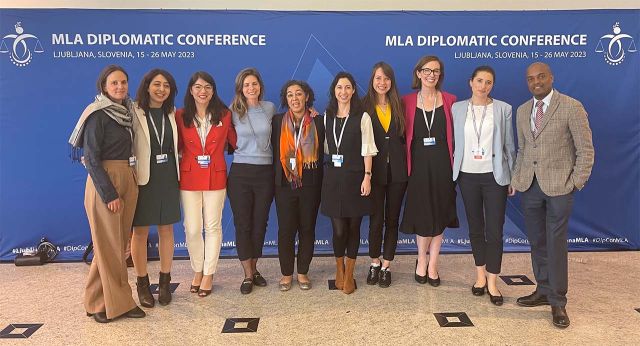
- The Ljubljana-The Hague Convention: Adopted in May 2023 by 68 states, the Ljubljana-The Hague Convention establishes an explicit legal framework for mutual legal assistance and extradition for the most serious international crimes. By facilitating practical cooperation between states investigating and prosecuting core international crimes at the national level, including genocide, war crimes, and crimes against humanity, the Convention strengthens national judicial systems and enables States to fulfil their international legal obligations in the fight against impunity and deliver justice to victims' groups and survivors. For this treaty to be fully effective, ratification and domestic implementation are crucial steps in which parliamentarians can play a decisive role.
This dialogue reaffirmed the crucial mandate of parliamentarians to transform political commitments into enforceable legal frameworks. As demonstrated by the enriching exchanges among participants, their voices and efforts are fundamental to advance international justice and fight against impunity.
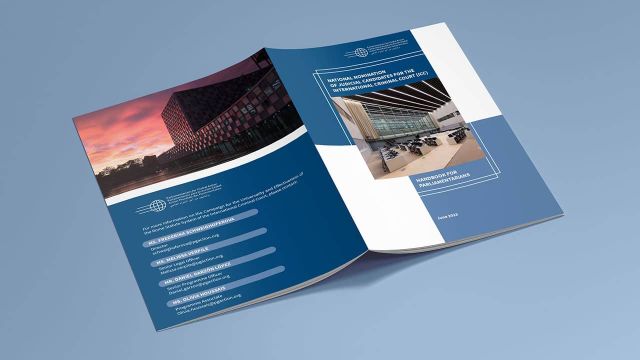
National Nomination of Judicial Candidates for the International Criminal Court