



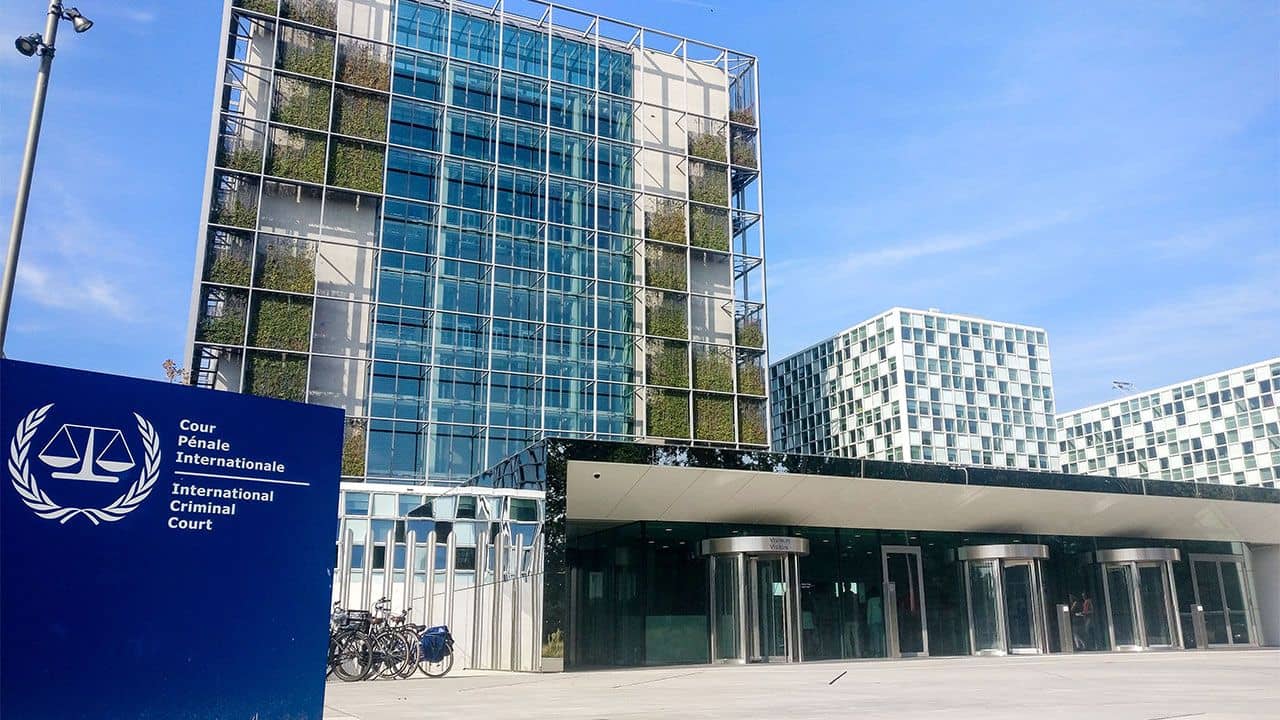
Comoros, a signatory of the Rome Statute, deposited at the UN its instrument of ratification of the Rome Statute on 18 August 2006, as a result of PGA Members in the Parliament of Comoros.
Congo (Brazzaville) signed the Rome Statute on 17 July 1998, and ratified on 3 May 2004, becoming the 94th state party.
Colombia signed the Rome Statute on 10 December 1998 and ratified it on 5 August 2002.
PGA Members in Côte d’Ivoire have promoted the fight against impunity since 2001. These efforts culminated in 2012 with the ratification of the Rome Statute and in 2015 with the adoption of an implementing legislation.
Costa Rica deposited its instrument of ratification of the Rome Statute on 7 June 2001.
Cook Islands acceded to the Rome Statute on July 18th, 2008 becoming the 108th State Party to the ICC.
Croatia deposited its instrument of ratification of the Rome Statute on 21 May 2001.
On 21 July 2009, Czechia deposited the Instrument of Ratification of the Rome Statute of the International Criminal Court (ICC) at the United Nations in New York.
PGA Members in the Democratic Republic of Congo (DRC) – both in the National Parliament and in Provincial Assemblies - have been mobilized on promoting the fight against impunity since 2006.
Cyprus signed the Rome Statute on 15 October 1998 and ratified on 7 March 2002.
Denmark signed the Rome Statute on 25 September 1998. Denmark ratified on 21 June 2001, becoming the 35th State Party.
Djibouti signed the Rome Statute on 7 October 1998 and ratified it on 5 November 2002.
Dominica acceded to the Rome Statute on 12 February 2001, becoming the 29th State Party.
PGA has a long and solid partnership history with the Dominican Republic, a state party to the Rome Statute, of promoting the fight against impunity for the most serious crimes of international concern.
Since ratification, PGA’s priority in Ecuador has been the adoption of complete domestic legislation containing the crimes and core principles included in the Rome Statute as well as provisions to set a national mechanism to fulfill the cooperation obligation with the ICC.
Since 2002, Parliamentarians for Global Action has been working on El Salvador’s accession to the Rome Statute. El Salvador became the 124 State Party to the International Criminal Court on 3 March 2016..
Estonia signed the Rome Statute on 27 December 1999 and deposited its instrument of ratification of the same Statute on 30 January 2002.
|
|
|
|
|
|
|
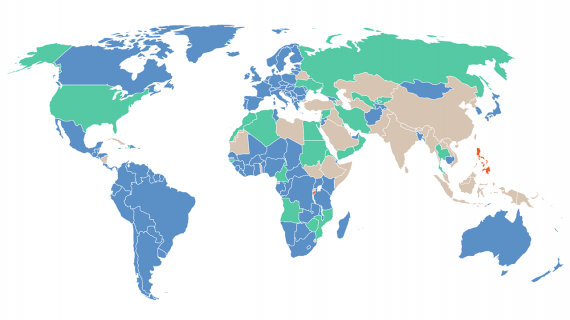
125 countries are States Parties to the Rome Statute of the International Criminal Court. Of these, 33 are African States, 19 are Asia-Pacific States, 20 are from Eastern Europe, 28 are from Latin American and Caribbean States, and 25 are from Western European and other States. |
It is imperative that the Rome Statute be ratified universally for the successful functioning of the Court. Parliamentarians should ensure that the ICC is truly universal.
Created by the Rome Statute, the International Criminal Court (ICC) is the first permanent and independent international court capable of investigating and bringing to justice individuals who commit the most serious violations of international criminal law, international humanitarian law, and human rights.
The Rome Statute defines the crimes under the Court’s jurisdiction and provides the general principles and procedures for the operation of the Court. It also outlines the cooperation obligations of its State Parties. It is imperative that the Rome Statute be ratified universally for the successful functioning of the Court. Parliamentarians should ensure that the ICC is truly universal.
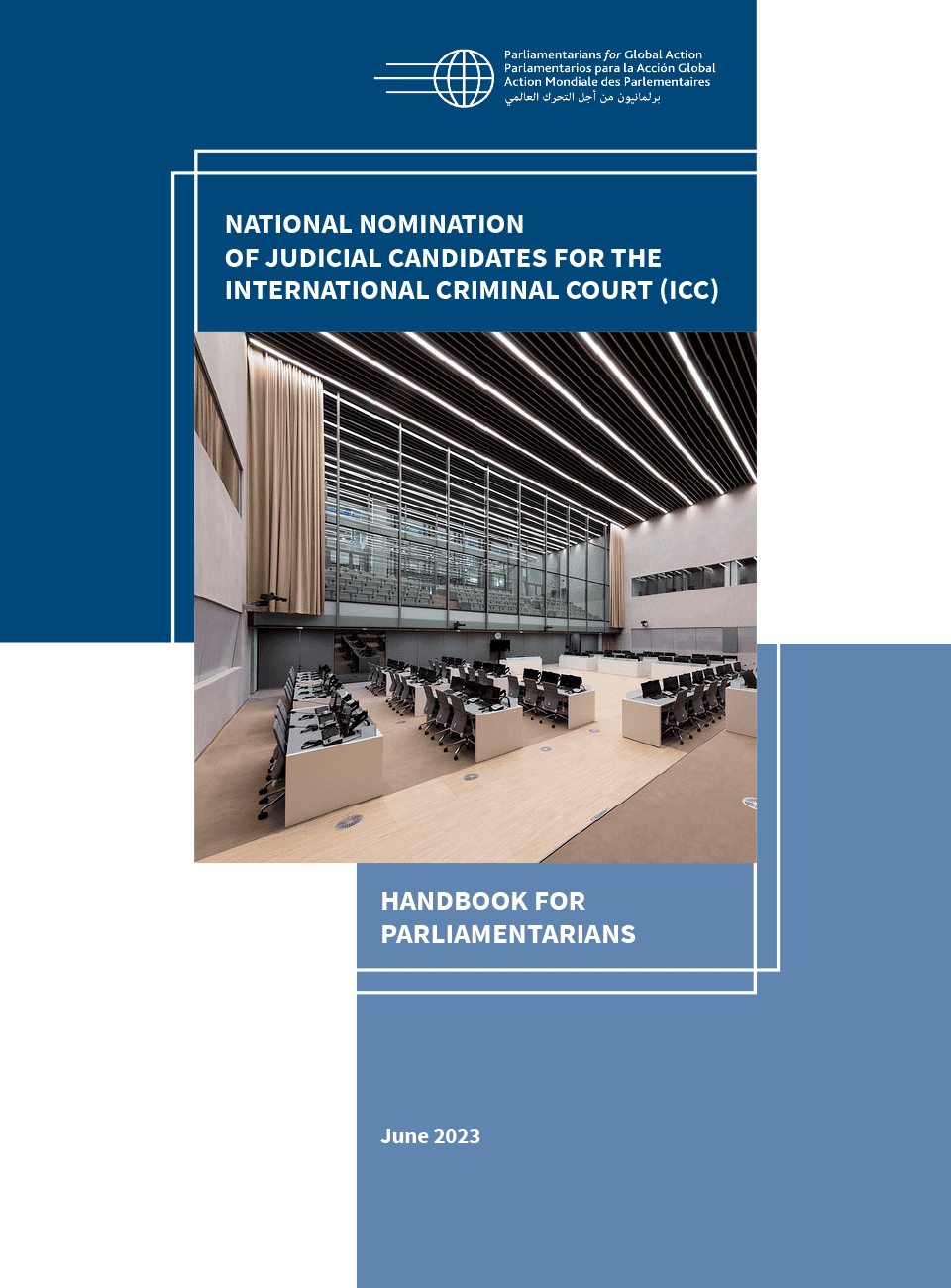
Criteria and recommendations for parliamentarians to improve national nomination procedures for International Criminal Court judicial candidates.
The ICC is the first and only permanent independent court with the mandate to investigate and prosecute individuals responsible for committing international crimes, namely genocide, crimes against humanity, war crimes, and the crime of aggression. Its 18 judges from around the world, elected for a nine-year term, play a key role in ensuring this expectation is lived up to through their primary mandate to render authoritative and high-quality jurisprudence and guarantee fair trials.
Therefore, the quality of the judges has fundamental importance to the performance, efficiency, and effectiveness of the ICC, which is at the heart of the long-term success of the ICC and the Rome Statute system as a whole. In this handbook, PGA sets forth specific criteria and recommendations for Parliamentarians to encourage their governments to improve national nomination procedures for ICC judicial candidates and adopt good practices and requirements to ensure these processes are fair, transparent, and merit-based. The goal of robust nomination procedures is to ensure that only candidate judges or jurists of the highest caliber make it on the ballot.
A handbook aimed at assisting States in ratifying the Kampala Amendments, helping criminalize the most serious forms of the illegal use of force.
It is our honor and privilege to present to you the Third Edition of the Handbook on the Ratification and Implementation of the Kampala Amendments on the Crime of Aggression to the Rome Statute of the ICC.
It is the product of our collaborative effort aimed at assisting States in ratifying the amendments adopted by consensus in Kampala and helping criminalize the most serious forms of the illegal use of force.