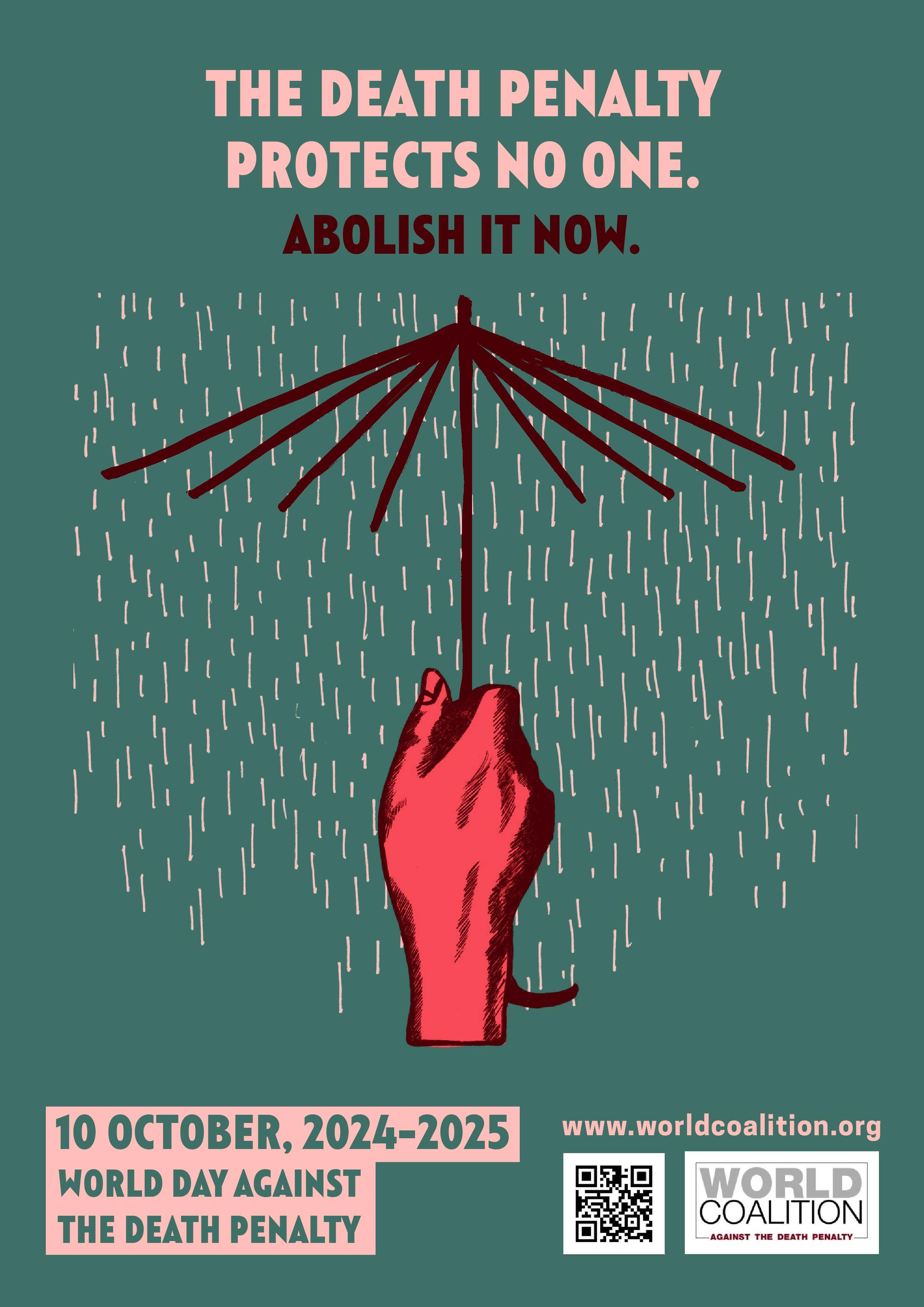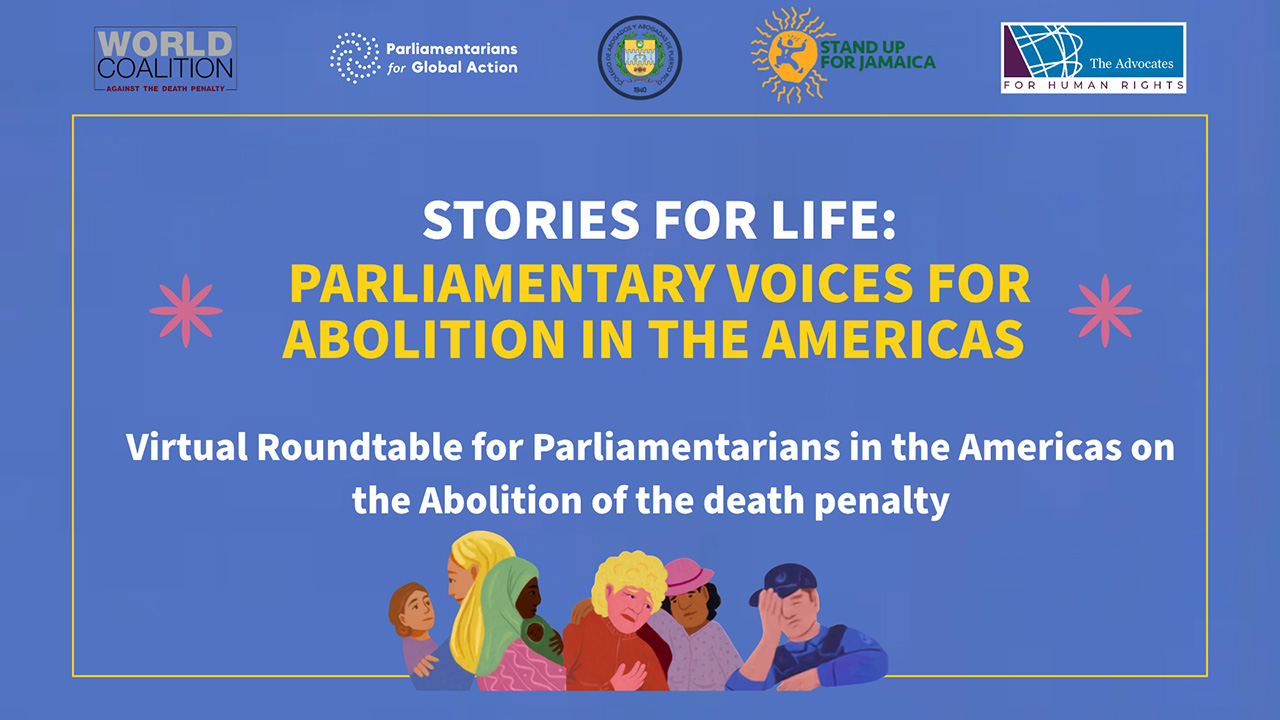



Each year on 10 October, the global abolitionist movement comes together to observe the World Day Against the Death Penalty. In 2024 and 2025, the focus has been on addressing the myth that the death penalty ensures safety, with the message: “The Death Penalty Protects No One: Abolish it Now.”
A primary duty of any country’s government is to ensure the security of citizens. Living in a safe and secure society not only means living in a community free from conflict. It also requires creating the conditions that foster peace, uphold accountability, and protect individuals from threats and violations of their fundamental rights and freedoms. The death penalty has no place in these societies.
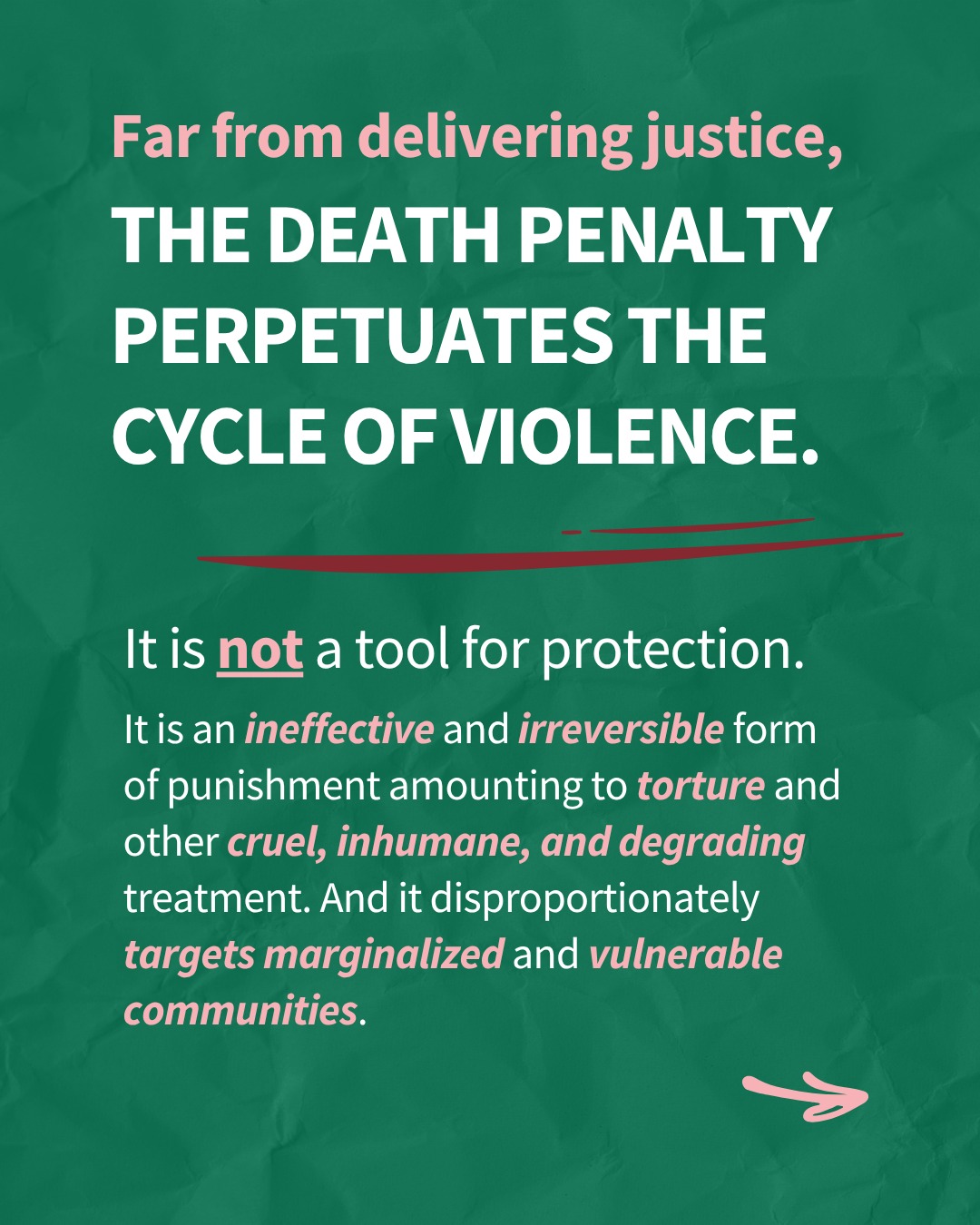
We are living in challenging times, marked by escalating global crises and the erosion of the rules-based international order. But as complex as the current context may be, no one should justify executions as a means of strengthening security. The death penalty protects no one, and to claim otherwise, is both false and dangerous. The use of capital punishment perpetuates cycles of violence and disproportionately targets marginalized and vulnerable communities. It is an ineffective, irreversible punishment that amounts to torture and other cruel, inhumane, and degrading treatment.
A year of contrasts for abolitionists
The World Day Against the Death Penalty’s bi-yearly theme has focused on the link between the death penalty and security, challenging the false narrative that executions ensure safety. It highlights the progress gained by advocates for abolition: fewer countries are carrying out executions and retentionist countries are increasingly isolated. Today, 113 countries have abolished the death penalty in law and 29 countries observe a moratorium on executions. This means that 77% of the world’s countries no longer carry out executions.
Yet despite this progress, there has been a sharp rise in executions, with at least 1,518 people executed in 2024 across just 15 countries — the second consecutive year in which executions reached their highest level since 2015 according to Amnesty International. This alarming trend has continued into 2025, with more than 1,000 executions already recorded in Iran alone — the highest figure in over three decades according to the NGO Iran Human Rights.
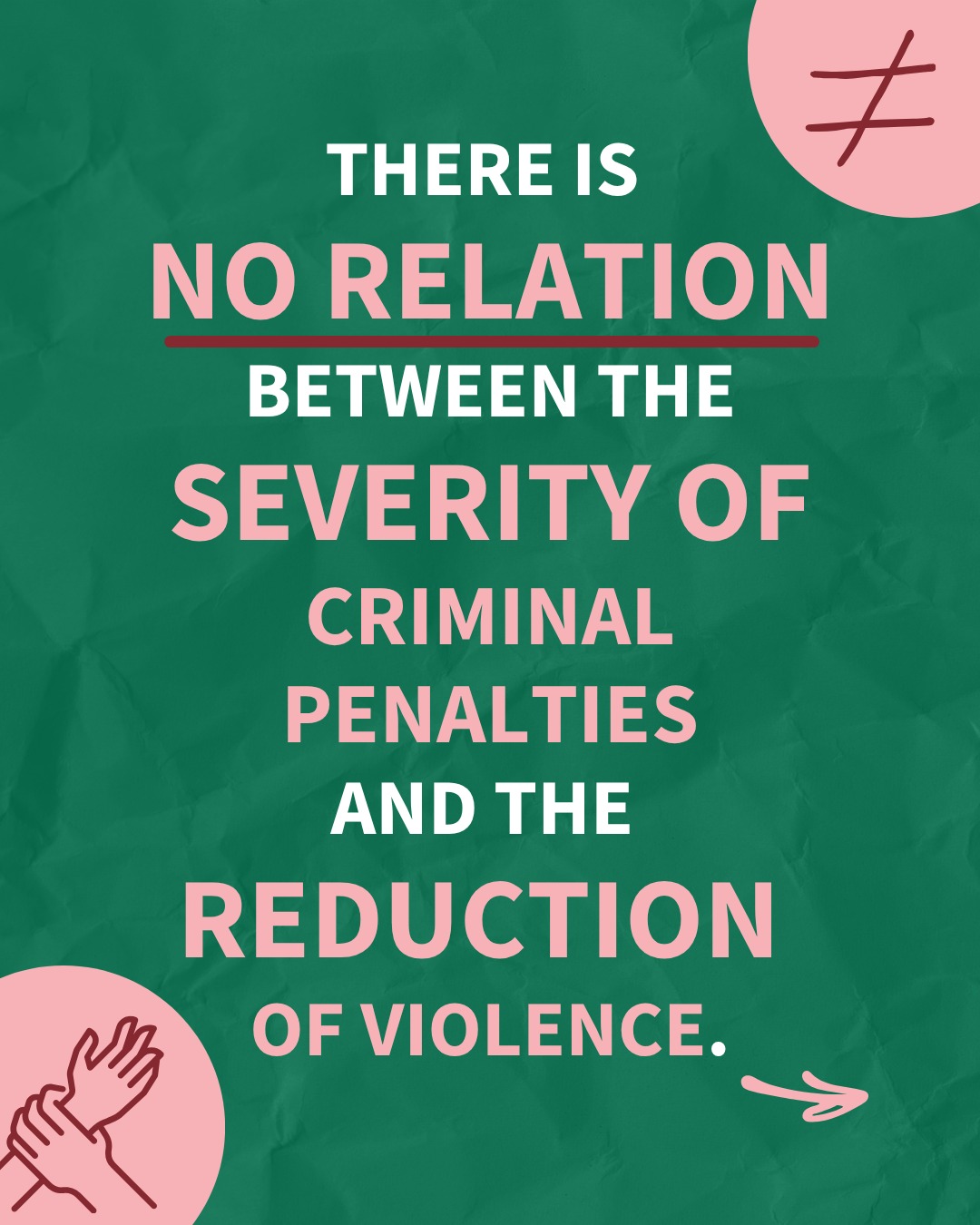
Many of these recorded executions are carried out under the guise of maintaining public order (despite clear evidence that the death penalty does not deter crimes). They also violate international law, as they fail to meet the “most serious crimes” threshold (defined as crimes of extreme gravity involving intentional killing). For example, in 2024, 43% of recorded executions were for drug-related offences, which do not meet this criterion.
While there is growing consensus to put an end to the death penalty, continued action is vital to prevent backsliding and promote universal abolition. The international community must redouble efforts to combat punitive narratives and to reaffirm a human rights-based approach to justice and security.
Dangerous revivals: security as a pretext for executions
In several countries, some political leaders are reviving rhetoric that equates security with punishment, calling for reinforcement or even the reintroduction of capital punishment. Some very recent developments are particularly worrying:
- United States: a Presidential proclamation reintroduces the death penalty in Washington D.C. to “deter and punish the most heinous crimes.”
- Kyrgyzstan: the President instructed the drafting of a bill to reinstate the death penalty for severe crimes against children and women, despite the country’s abolition in 2007 and its commitment under the Second Optional Protocol to the International Covenant on Civil and Political Rights to abolish the death penalty.
- Chad: a new commission has been established to consider restoring the death penalty, only four years after the country abolished the death penalty.
- Israel: a bill allowing the death penalty for “terrorist” crimes has passed its first reading.
Invoking “security” to justify executions is common political rhetoric. Security comes by addressing the root causes of violence, ensuring the good management of security and justice sectors, while promoting accountability. Resorting to the death penalty only deepens social divisions, entrenches unfairness and replaces justice with vengeance.
Even in the most difficult contexts of insecurity and conflict, we have chosen the path of abolition – proof that strong political will can pave the way for positive change. We know that executions bring neither peace nor justice. Only truth, accountability and reparations can do that. Abolishing the death penalty means investing in human rights. I call on my fellow parliamentarians around the world to work together to ensure that the death penalty becomes a thing of the past. Hon. Émilie Béatrice Epaye, MP (Central African Republic), member of Parliamentarians for Global Action
Parliamentarians at the forefront of abolition
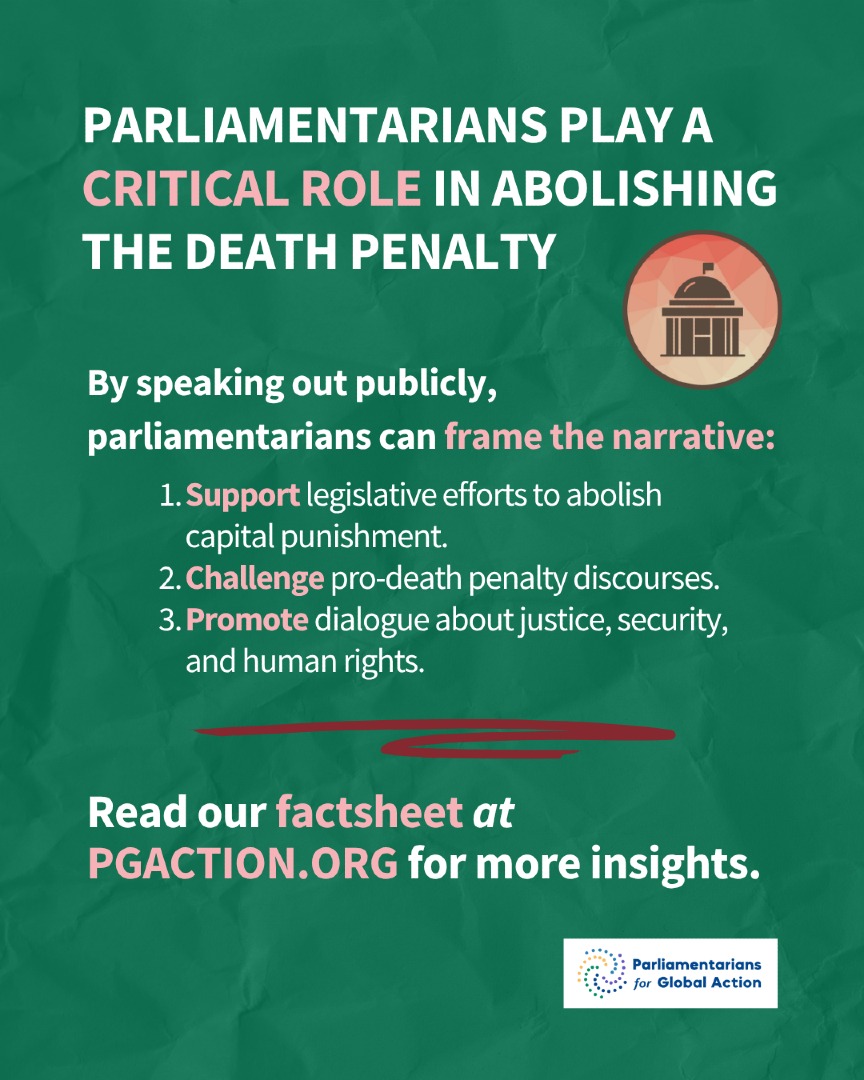
Parliamentarians have a crucial role to play in advancing universal abolition of the death penalty and countering the narrative that seek to justify it, whether they hold roles in abolitionist, abolitionist in practice, or retentionist countries. Legislators have the power to amend, draft, and adopt legislations that narrow the scope of the death penalty and lead to its eventual abolition.
To support these efforts, Parliamentarians for Global Action and the World Coalition Against the Death Penalty published a factsheet in honor of World Day: “The Death Penalty Protects No One.” The publication outlines how governments have used “security” as a political tool to justify executions and provides parliamentarians with clear arguments and practical steps to counter these false narratives and drive action towards universal abolition.
As punitive narratives regain ground in many parts of the world, this work has never been more urgent. Executions neither deter crime nor promote safety: they perpetuate fear and inequality.
Parliamentarians, regardless of their country’s current stance on the death penalty, can take concrete action to promote universal abolition:
- Support or initiate legislative efforts that restrict and ultimately abolish capital punishment.
- Collaborate with like-minded parliamentarians across party lines to identify legislative strategies for universal abolition.
- Promote the universal ratification or accession to relevant regional or international instruments, such as the Second Optional Protocol to the International Covenant on Civil and Political Rights to abolish the death penalty.
- Challenge pro-death penalty narratives, including by publicly committing not to call for its use, even in contexts of insecurity, and promoting stronger accountability systems and policies that address the root causes of violence.
- Promote dialogue about justice, security, and human rights, and engage with citizens, victims’ associations, civil society organizations, and other relevant stakeholders.
On this World Day, PGA call on its members to stand with the abolitionist movement, reaffirming a clear message: the death penalty protects no-one, abolish it now.