


Loading...

Organization of American States (OAS)

Organization of American States (OAS)

What is the OAS?

The Organization of American States (OAS) is a continental organization that was founded on 30 April 1948 to promote regional solidarity and cooperation among its member States. Headquartered in the United States capital Washington, D.C., the OAS's members are the 35 independent states of the Americas.

PGA’s Work

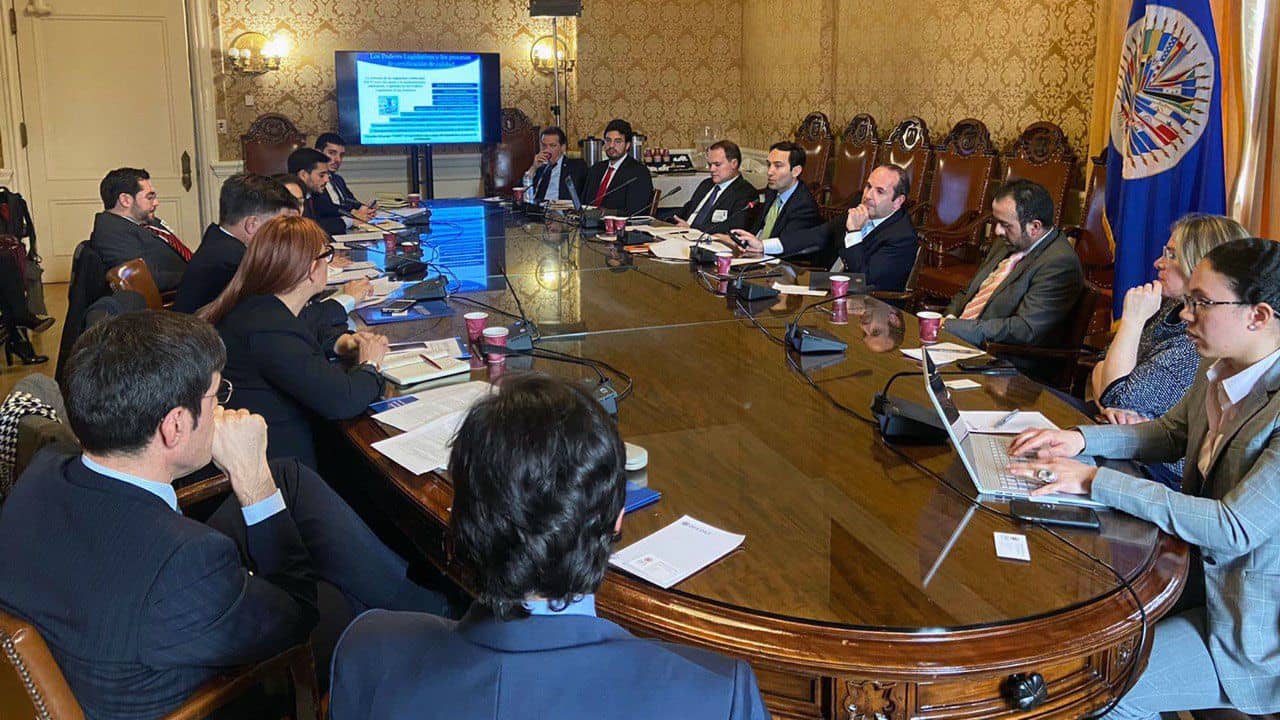
  • On 24 February 2020, the OAS and PGA signed a Memorandum of Understanding (MoU) and co-organized an institutional dialogue on the Role of Parliamentarians as Defenders of Democracy in the Digital Era. Being the first activity of PGA under its new core Campaign for Democratic Renewal and Human Rights, the meeting ushered in enhanced cooperation between the two institutions on topics of common interest, including the Legislative Power in the 21st century; technological innovation in parliamentary management and communication; and cybersecurity challenges to the Legislative Power.
  • In the framework of the MoU, both organisations co-organized on 15 May 2020, a webinar on the “ Political parliamentary action in times of COVID-19” which Latin American legislators to address how the current crisis is impacting political action and what are the tools to prepare for an adequate post-COVID-19 political response.
  • The cooperation of PGA with the OAS is a long-standing one, which has been punctuated by significant moments. Among these moments, the presentation on 10 February 2016 of the former PGA President, Dip. Minou Tavarez Mirabal, to the Committee on Judicial and Political Affairs of the OAS at its regular high-level session on the ICC. Indeed, the commitment of PGA members from Latin America to the universality and implementation of the Rome Statute has been showcased on several occasions. PGA members from the region have intervened at the Working Session on the ICC convened by the Permanent Council of the OAS.
  • On 15 March 2018, PGA, participated in the 10th Special Session of the OAS on the ICC, organized by the Committee on Juridical and Political Affairs. During this high-level meeting, the dialogue between participants dealt with the measures that countries and other relevant stakeholders can take to strengthen the Rome Statute system, through the promotion of universality, implementation and cooperation with the ICC, of particular significance to commemorate the 20th anniversary of the adoption of the Rome Statute.
  • On behalf of PGA, Dip. Jorge Cálix delivered a strong speech emphasizing the need for the universality of the Rome Statute, in the Americas. To this effect, Dip. Cálix emphasized that the OAS can play a significant role to foster political will in the region, inter alia to promote accountability for international crimes through the ratification and implementation of the Rome Statute, as well as promoting cooperation mechanisms with the ICC and its member States. The OAS can also provide a forum for countries that have publicly expressed their intention of becoming a States Party to the Rome Statute, for example, Haiti and Jamaica. Dip. Calix explicitly called on these two countries to ratify the Rome Statute.
  • The Permanent Representative of the OAS in Uruguay has regularly been invited and participated in the annual PGA Latin American sub-regional seminars on the ICC and the Rule of Law in Montevideo, Uruguay.
Status of the Rome Statute System as of October 2024:

 
States that have ratified the Rome Statute [125]
 
States that have signed the Rome Statute but have not ratified it yet [29]
 
States that have withdrawn from the Rome Statute [2]
 
States that have neither signed nor ratified the Rome Statute
 

125 countries are States Parties to the Rome Statute of the International Criminal Court. Of these, 33 are African States, 19 are Asia-Pacific States, 20 are from Eastern Europe, 28 are from Latin American and Caribbean States, and 25 are from Western European and other States.

Work of PGA in this Country:

Publication

Parliamentary Kit on the International Criminal Court

Parliamentary Kit on the International Criminal Court

It is imperative that the Rome Statute be ratified universally for the successful functioning of the Court. Parliamentarians should ensure that the ICC is truly universal.

Description

Created by the Rome Statute, the International Criminal Court (ICC) is the first permanent and independent international court capable of investigating and bringing to justice individuals who commit the most serious violations of international criminal law, international humanitarian law, and human rights.

The Rome Statute defines the crimes under the Court’s jurisdiction and provides the general principles and procedures for the operation of the Court. It also outlines the cooperation obligations of its State Parties. It is imperative that the Rome Statute be ratified universally for the successful functioning of the Court. Parliamentarians should ensure that the ICC is truly universal.

PDF(s)

Additional Details

  • Publication Type: Toolkit
  • Author(s): Parliamentarians for Global Action

Publication

National Nomination of Judicial Candidates for the International Criminal Court

National Nomination of Judicial Candidates for the International Criminal Court

Criteria and recommendations for parliamentarians to improve national nomination procedures for International Criminal Court judicial candidates.

Description

The ICC is the first and only permanent independent court with the mandate to investigate and prosecute individuals responsible for committing international crimes, namely genocide, crimes against humanity, war crimes, and the crime of aggression. Its 18 judges from around the world, elected for a nine-year term, play a key role in ensuring this expectation is lived up to through their primary mandate to render authoritative and high-quality jurisprudence and guarantee fair trials.

Therefore, the quality of the judges has fundamental importance to the performance, efficiency, and effectiveness of the ICC, which is at the heart of the long-term success of the ICC and the Rome Statute system as a whole. In this handbook, PGA sets forth specific criteria and recommendations for Parliamentarians to encourage their governments to improve national nomination procedures for ICC judicial candidates and adopt good practices and requirements to ensure these processes are fair, transparent, and merit-based. The goal of robust nomination procedures is to ensure that only candidate judges or jurists of the highest caliber make it on the ballot.

PDF(s)

Additional Details

  • Publication Type: Handbook
  • Author(s): Parliamentarians for Global Action

Publication

Ratification and Implementation of the Kampala Amendments on the Crime of Aggression to the Rome Statute of the International Criminal Court

Ratification and Implementation of the Kampala Amendments on the Crime of Aggression to the Rome Statute of the International Criminal Court

A handbook aimed at assisting States in ratifying the Kampala Amendments, helping criminalize the most serious forms of the illegal use of force.

Description

It is our honor and privilege to present to you the Third Edition of the Handbook on the Ratification and Implementation of the Kampala Amendments on the Crime of Aggression to the Rome Statute of the ICC.

It is the product of our collaborative effort aimed at assisting States in ratifying the amendments adopted by consensus in Kampala and helping criminalize the most serious forms of the illegal use of force.

PDF(s)

Additional Details

  • Publication Type: Handbook
  • Author(s): Permanent Mission of the Principality of Liechtenstein to the United Nations; Global Institute for the Prevention of Aggression; Liechtenstein Institute on Self-Determination at Princeton University (LISD); (Drafting Assistance by PGA)