


Background
The call to recognize the crime of gender apartheid as a crime against humanity first emerged in the 1990s, when UN experts reported that the Taliban had “introduced what is in point of fact a system of apartheid in respect of women.” Yet, no concrete action led to enshrining this crime in international law, leaving a persistent accountability gap for its survivors and victims.
Gender apartheid is unique in its intent and institutionalized character: it aims not only to discriminate against a group based on their gender identity through inhumane acts, but also to establish and maintain a system of domination and total exclusion of that group from the social, economic, cultural, and political life of a country.
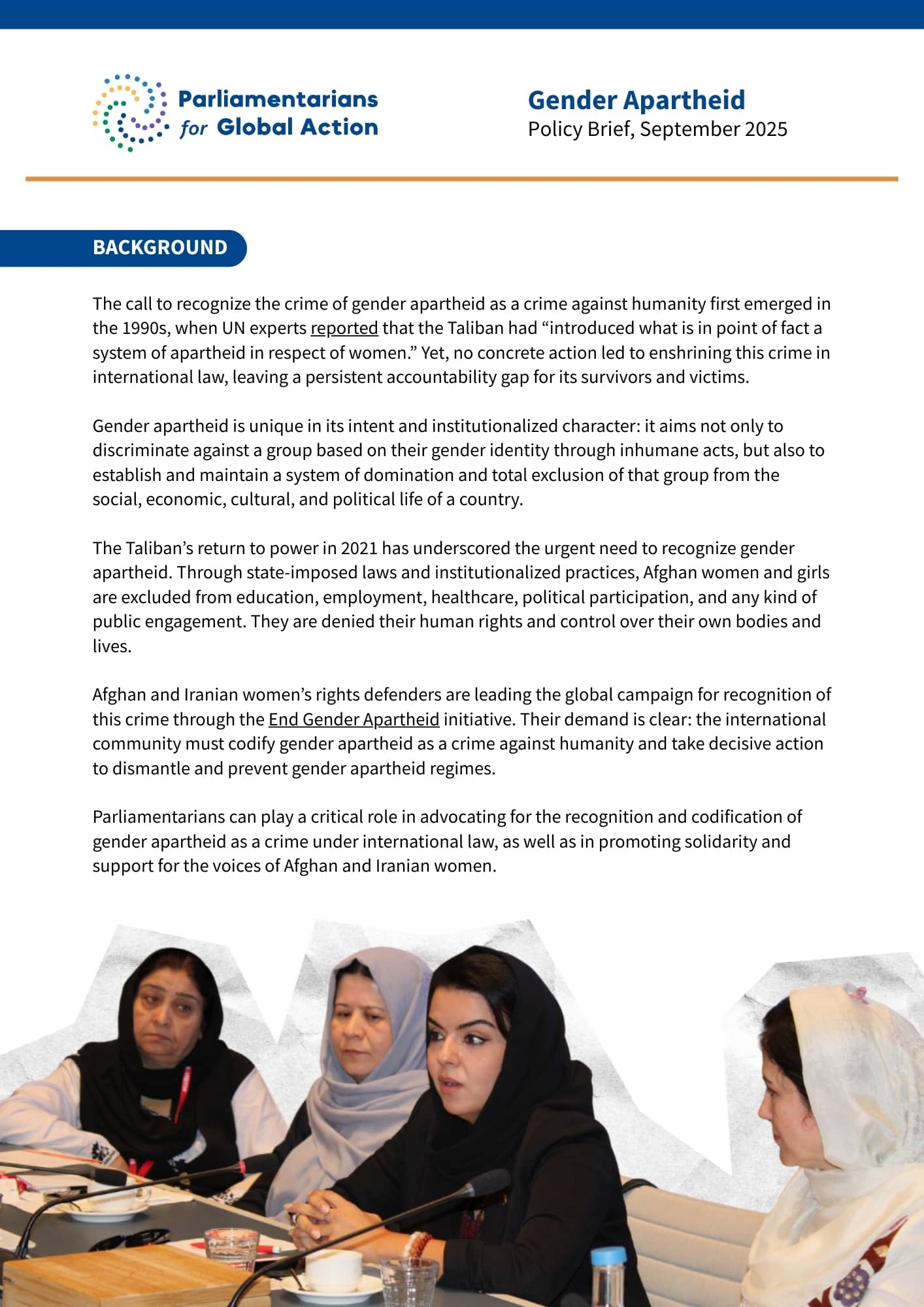
The Taliban’s return to power in 2021 has underscored the urgent need to recognize gender apartheid. Through state-imposed laws and institutionalized practices, Afghan women and girls are excluded from education, employment, healthcare, political participation, and any kind of public engagement. They are denied their human rights and control over their own bodies and lives.
Afghan and Iranian women’s rights defenders are leading the global campaign for recognition of this crime through the End Gender Apartheid initiative. Their demand is clear: the international community must codify gender apartheid as a crime against humanity and take decisive action to dismantle and prevent gender apartheid regimes.
Parliamentarians can play a critical role in advocating for the recognition and codification of gender apartheid as a crime under international law, as well as in promoting solidarity and support for the voices of Afghan and Iranian women.
What is gender apartheid?
The crime of apartheid is an internationally recognized crime against humanity, rooted in the history of South Africa. The International Convention on the Suppression and Punishment of the Crime of Apartheid and the Rome Statute of the International Criminal Court define it as the institutionalized domination of one racial or ethnic group over another. However, neither of these instruments extends the concept to include gender-based forms of apartheid.
UN experts and human rights advocates have documented gender persecutions and violations in countries such as Afghanistan and Iran, where state-designed, coordinated, and institutionalized mechanisms are used to oppress a specific group based on their gender. This results in their exclusion and separation from the country’s social, economic, cultural, and political life. In Afghanistan, the elimination of rights and freedoms of women and girls, imposed by Taliban laws, policies, and practices, reflects the system of apartheid based on gender.
The current definition of the crime of apartheid in the Rome Statute of the International Criminal Court should therefore be adapted to recognize gender apartheid, conceptualized as: “inhumane acts committed in the context of an institutionalized regime of systematic oppression and domination by one gender group over any other gender group or groups and committed with the intention of maintaining that regime.”
Why recognizing and naming gender apartheid matters
Under international law, there is currently no recognition of the crime of gender apartheid. While available legal tools, such as the crime of gender persecution, address the existence of serious violations depriving individuals of rights on the basis of gender, they do not account for the systematic, state-designed, and institutionalized nature of gender apartheid. Nor do they reflect the specific intent to maintain a regime of domination, which is an element that distinguishes apartheid from other crimes against humanity.
In the fight against impunity, crimes must be named, defined, and codified to ensure that perpetrators are held accountable, victims and survivors obtain justice and reparations, and future violations are prevented. Without codification in legal frameworks, the cycle of violence cannot be broken, leaving victims and survivors without remedies and perpetuating an accountability gap.
Recognizing gender apartheid as a crime against humanity would complement existing provisions on gender-based crimes and human rights violations, while creating a stronger legal framework to hold accountable regimes that seek to erase women and girls from the social, economic, cultural, and political life of a country.
Ongoing developments and opportunities for recognition of the crime of gender apartheid
The leadership of Afghan and Iranian women’s rights defenders has grown momentum to codify the crime of gender apartheid as a crime against humanity. The term is now increasingly used by experts, civil society organizations, parliamentarians, and other stakeholders, creating a unique window of opportunity to recognize it under international law.
1) The Convention on Crimes Against Humanity
The most immediate and concrete opportunity lies in the ongoing negotiations of a new UN Convention on Crimes Against Humanity, where countries could ensure that gender apartheid is explicitly recognized and defined. This process requires strong political support to avoid gender apartheid being sidelined. In November 2024, countries adopted a resolution mandating a Conference of Plenipotentiaries to convene in 2028 and then in 2029, to negotiate the final text of the Convention with the aim of opening it for signature and ratification thereafter. During 2026, a preparatory committee will review draft articles and consider proposed amendments, thus providing an opening to advocate for the inclusion of gender apartheid in the Convention.
2) Amending the Rome Statute
A parallel path to include gender apartheid as an international crime is to amend the Rome Statute of the International Criminal Court, granting the Court the mandate to investigate this crime and prosecute its perpetrators — thereby recognizing the individual criminal responsibility in the commitment of this crime. This route, however, may be lengthy and would require significant political will: any State Party to the Rome Statute may propose amendments, which must be adopted by consensus or a two-thirds majority of States Parties at the Assembly of States Parties or a Review Conference. To date, no formal amendment on this matter has been introduced, making this a crucial moment to open debate among States Parties to take leadership in advancing recognition of gender apartheid within the Rome Statute system.
3) Collecting data in line with the SDGs
To ensure effective monitoring and accountability, parliamentarians should call for the systematic tracking of indicators that reveal the scope and impact of gender apartheid, framed within the Sustainable Development Goals (SDGs). These include access to education (SDG 4), particularly the enrollment and attendance of girls at the secondary and tertiary levels; women’s participation in the labor force and access to decent work (SDG 8); restrictions on freedom of movement, including the enforcement of male guardianship and compulsory dress codes (SDG 5 and SDG 16); and the prevalence of punishments, arrests, and surveillance technologies used to enforce gender-based segregation (SDG 9 and SDG 16). By collecting and publishing disaggregated data on these indicators, parliaments can both identify areas where systemic oppression persists and evaluate progress toward achieving gender equality under SDG 5.
Given the upcoming United Nations General Assembly in September 2025 in New York, parliamentarians have a timely opportunity to advocate for the integration of these indicators into global reporting frameworks, thereby strengthening international consensus and accountability on eliminating gender apartheid.
What can parliamentarians do?
Parliamentarians can open debates on gender apartheid to push the issue to the top of national and international agendas and to adopt recommendations for its legal codification and global recognition. As a parliamentarian, you can:
Advocate for the recognition and codification of gender apartheid:
- Call on your government to support the inclusion of gender apartheid in the draft UN Convention on Crimes Against Humanity.
- Call on your government to initiate support for proposing an amendment to include gender apartheid in the Rome Statute of the International Criminal Court.
- Establish parliamentary working groups and issue parliamentary resolutions dedicated to the recognition and codification of gender apartheid at the national, regional, and international levels.
Promote solidarity and support:
- Elevate the voices of Afghan and Iranian women’s rights defenders leading the global campaign to End Gender Apartheid, notably by including them in any discussions or events related to the issue.
- Engage with international organizations and civil society groups to raise awareness and advocate for the inclusion of gender apartheid under international law.
Ensure effective monitoring:
- Call for the systematic tracking of indicators that reveal the scope and impact of gender apartheid, framed within the Sustainable Development Goals (SDGs).
Parliamentary actions by PGA members
- In the Parliamentary Assembly of the Council of Europe: Petra Bayr, MP (Austria) and member of PGA Executive Committee, introduced a resolution adopted on June 26, 2025 urging “Council of Europe member States that are Parties to the Rome Statute of the International Criminal Court to consider proposing an amendment to the statute in order to include the crime of ‘gender apartheid’.”
- In the Netherlands: PGA organized a roundtable on gender justice for Afghanistan in June 2025 bringing together Dutch Senators, Afghan parliamentarians in exile, and experts to foster dialogue on the need for gender accountability in Afghanistan and the recognition of gender apartheid.
- In the European Parliament: Members — including PGA member Hannah Neumann, MP (Germany) — tabled a motion for a resolution adopted on September 19, 2024, calling the “EU to support the recognition of gender apartheid as a crime against humanity.”
- In Canada: on April 18, 2024, Mr. Ali Ehsassi, chair of PGA’s International Council, introduced two petitions in the Senate of Canada, on behalf of Afghan and Iranian women, respectively. The petitions demanded that international institutions recognize gender apartheid as a crime against humanity under international law, advocating for feminist principles and for universalism of human rights to be reflected in existing and emergent international law. The petitions urged other countries to take steps to adopt similar policies.
- In the United Kingdom: In 2024, Baroness Kennedy of The Shaws LT KC, director of the International Bar Association’s Human Rights Institute (IBAHRI) and PGA member, established an ad-hoc parliamentary inquiry on gender apartheid to examine the issue and push for government action.