



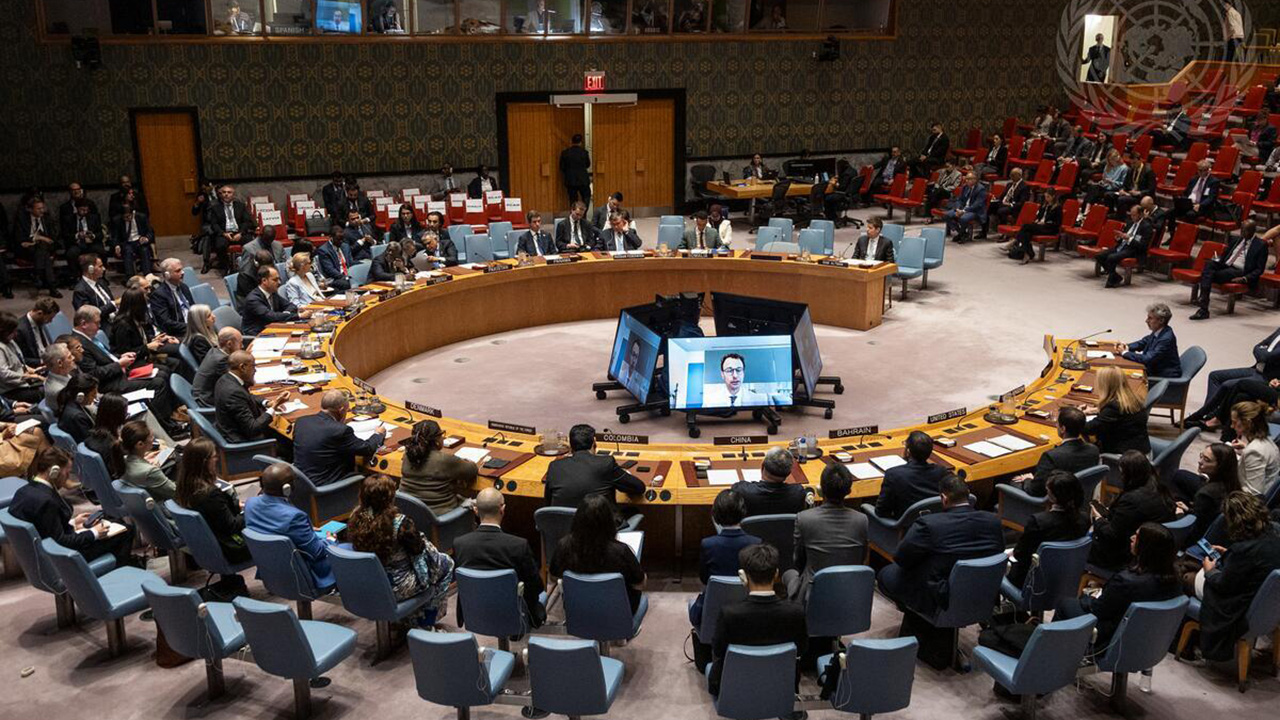
Dario Amodei (on screen), Chief Executive Officer of Anthropic, briefs the UN Security Council meeting on Artificial Intelligence and International Security.
Credit: UN Photo/Ariana Lindquist
Parliamentarians, as influential advocates and lawmakers, make decisive contributions in promoting the adoption of, and subsequent signature and ratification of vital international treaties. It is clear that action is now urgently needed to address the risks, threats and challenges posed by unregulated AI - in a coordinated multilateral way. Appropriate guardrails and AI safety are in the best interests of everyone, including those at the forefront of AI development and research. Several countries have already identified the need for an international instrument. In September 2026, at the United Nations in New York, Singapore formally proposed for the first time that the international community should consider a UN Framework Convention on AI Safeguards.
As PGA has done before in connection with other serious global challenges, such as for the negotiation and adoption of the Arms Trade Treaty, this Global Parliamentary Declaration seeks to mobilize parliamentarians worldwide to encourage their governments to promptly engage in support of negotiations for a UN Framework Convention on AI Safeguards. Signing this Global Parliamentary Declaration sends a powerful message of support and solidarity among parliamentarians and across boundaries that failure to meet this moment with political will and cooperation will have consequences that none of us will wish to bear.
PGA Global Parliamentary Declaration for Adoption of a UN Framework Convention on AI Safeguards
Humanity is adapting to a world in which artificial intelligence (AI) plays an increasingly central role in our daily existence.
We recognize and embrace the extraordinary promise and potential of AI in improving the quality of our personal and professional lives.
We recognize also the necessity to harness this extraordinary emerging technology in a way that continues to foster innovation as well as achieving life changing scientific advances, in addition to attaining many other progress indicators in agriculture, education, trade and healthcare, among other sectors.
Mindful, however, that, if left inadequately regulated, artificial intelligence can be perilous, posing profound risks, threats and challenges, including some that we may not yet be able to fully comprehend, and which could also be existential in nature. This stark reality must be addressed effectively and immediately, given the speed at which AI development and research is evolving, largely unrestrained, most notably in the context of so-called frontier AI models.
We are alarmed by the rapid increase of reported incidents of autonomous AI breaches of sensitive government and corporate sites as well as by numerous reports on the genuine possibilities for AI facilitated development of bioweapons and other weapons of mass destruction.
We are equally disturbed by the grave threats posed to human rights, democracy and the rule of law by inadequate AI regulation.
Cognizant also of the need for all countries worldwide to be engaged in addressing these threats and challenges, not merely those where AI frontier models are currently being developed, as the consequences of development and research in AI impact all people in all countries worldwide
Highlight that AI must always remain under human direction, oversight and control and be developed and used in conformity with international law.
Highlight also that secure and safe AI is integral to future development and that confidence in the safety of AI models and systems is a cornerstone of trade prosperity. The two propositions are mutually reinforcing, not mutually exclusive endeavors.
Taking into account also, in this connection, that those calling for greater governance of AI include many prominent private sector entities that are at the forefront of the development of next-generation AI frontier models and systems.
Recognizing also the following significant initiatives, among many others, already undertaken calling for improved regulation and governance of AI:
- UN General Assembly Resolution of November 21st 2024 on the promotion of safe, secure and trustworthy artificial intelligence (AI) systems for sustainable development
- The Global Call for Red Lines to Prevent Unacceptable AI Risks Launched during the 80th session of the United Nations General Assembly in September 2025
- The UN Global Dialogue on AI Governance
- The February 2026 New Delhi AI Declaration, endorsed by 88 countries formally recognizing the importance of security in AI systems
- The September 2026 AI Declaration signed by 30 countries worldwide as well as the European Union at the United Nations, calling for the control of frontier AI models, urging countries to coordinate common standards and implement pre-deployment safety testing as well as exploring the possibility of creating an institution that is able to set standards, enable verification, and convene countries when capability thresholds are crossed
- The September 2026 call for consideration of adoption of a UN Framework Convention on AI Safeguards by Singapore and supported by other States
We, parliamentarians from across the globe, endorse the call made at the United Nations in September 2026 to explore the possibility of adopting a United Nations Framework Convention on AI Safeguards.
We agree that any sustainable international approach. must give all countries a meaningful role, not only those with the most advanced frontier AI models. Everyone is impacted by AI.
We also agree that global cooperation over AI must begin now and that multilateral regulation in this arena is a benefit, not a hindrance to continued AI development and research. Such rules and regulations provide vital reassurances and confidence which are essential prerequisites for AI to evolve further and more effectively for the benefit of all.
We urge countries to mobilize without delay and to introduce a Resolution at the UN General Assembly to initiate the process leading to negotiation of a UN Framework Convention on AI Safeguards.
As parliamentarians, making full use of the important prerogatives we have at our disposal, we stand ready in our respective countries to lend our robust support to address these risks, threats and challenges in an effective way.