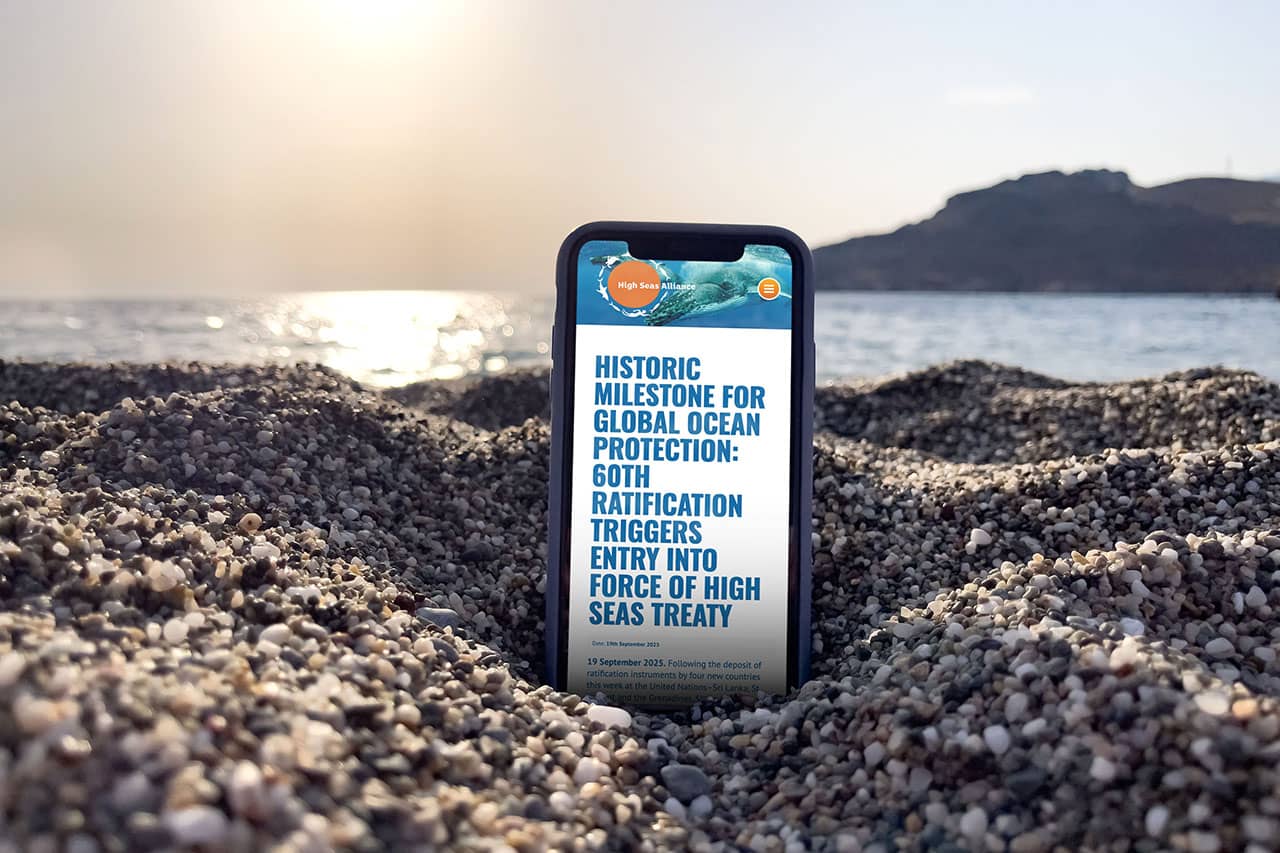



On September 19, 2025, in a momentous display of effective global cooperation, the High Seas Treaty achieved 60 ratifications, triggering its entry into force. This is a historic milestone for ocean governance and the first international, legally binding framework for the protection of the high seas. The Treaty will enter into force on January 17, 2026.
Two years after the finalization of the Treaty text, countries from every region of the world have come together to accelerate multilateral action towards the Treaty’s realization. The Treaty establishes a framework for the creation of marine protected areas, or MPAs, in areas beyond national jurisdiction. In doing so, it reinforces the 2030 Agenda for Sustainable Development and contributes to achieving the 30 by 30 goal to protect at least 30 percent of the ocean by 2030, as established in the Kunming-Montreal Global Biodiversity Framework.
Parliamentarians have championed the Treaty as an effective tool for global governance through PGA’s Oceans Campaign since 2019, and we look forward to continuing this historic momentum towards its effective implementation to protect this common heritage of humankind.
Over the years, PGA members have championed the protection of the high seas. A few statements below showing their support:
Our oceans are the lifeblood of our planet, and their health is directly tied to our right to a clean, healthy and sustainable environment for present and future generations. As we face the triple planetary crisis of biodiversity loss, pollution, and climate change, the need to protect our oceans has never been more urgent. Supporting the High Seas Treaty is a crucial step in this fight … As Parliamentarians, we must sign on to the High Seas Treaty as we must be committed to human rights and sustainable development. Hon. Naveed Qamar Syed, MP (Pakistan) PGA President
I am truly delighted that the BBNJ Agreement has now reached 60 ratifications. Even though I come from a landlocked country, I know that healthy oceans are essential for the wellbeing of our entire planet and for all of humanity. The high seas regulate our climate, provide food and livelihoods, and are home to an incredible diversity of life. This milestone is therefore much more than a legal achievement – it is a strong step toward protecting marine biodiversity, strengthening global cooperation, and safeguarding our shared future. Ms. Petra Bayr, MP (Austria), PGA Treasurer
The 60th ratification of the High Seas Treaty is a historic milestone for humanity and for the health of our planet. As parliamentarians, we understand that our oceans know no borders, and their protection demands bold collective action. This achievement reflects years of tireless advocacy, including the leadership of PGA members, to safeguard biodiversity beyond national jurisdiction. It is now our duty to ensure that this Treaty is fully implemented, so that future generations inherit oceans that are resilient, thriving, and a source of shared prosperity. Hon. Amanza Walton-Desir, MP (Guyana), PGA Board Member
With The Gambia's ratification bringing the BBNJ into force for 60 parties, the international community rededicates itself to safeguarding marine biodiversity beyond national jurisdiction. This historic milestone reinforces the UN's commitment to shared stewardship, equitable benefit-sharing, and capacity-building—ensuring sustainable ocean governance for current and future generations and resilient coastal communities. Hon. Abdoulie Ceesay, MP (The Gambia)
Anything that protects our planet deserves solid words and actions. Its preservation, therefore, must be our primary objective. The High Seas Treaty is necessary to safeguard the oceans.Hon. Roger Mancienne, Speaker of the National Assembly of the Republic of Seychelles during PGA’s 3rd CAP-Oceans
I want Seychelles to be one of the first countries to ratify the High Seas Treaty and it is my job to bring Treaty ratification to the floor for a vote.Hon. Bernard Georges, MP (Seychelles) during PGA’s 3rd CAP-Oceans
It was my love for the ocean that first brought me into politics. As both a marine biologist and a Swedish parliamentarian, I am truly delighted by the adoption of the BBNJ Agreement. This treaty is a milestone for protecting life in the high seas and for restoring faith in international cooperation. I hope countries will move swiftly towards ratification so that this historic achievement becomes real protection for our shared ocean. Ms. Emma Nohrén, MP (Sweden)
Any effort made in the direction of protecting the seas is an effort that we must support. This agreement goes in that direction, especially in those areas of the sea that are not part of the EEZ of the countries.Dep. Felix Gonzalez (Chile)
As the first landlocked country to ratify the High Seas Treaty, Malawi’s ratification comes as an important step towards environmental protection that benefits all of humankind. The urgent entry into force of this Treaty is vital to protect our oceans, our planet, and all people for generations to come.Hon. Roseby Gadama, MP (Malawi)
The future of marine ecosystems and livelihoods around the world depends on decisive action to protect marine biodiversity and to promote responsible and sustainable ocean use. Ratifying the High Seas Treaty is one clear action that addresses these environmental challenges in a meaningful way.Hon. Valerie Woods, MP, Speaker of the House of Representatives of Belize, PGA Board Member
We need to protect the human rights of our constituents to a healthy environment. The high seas are two-thirds of the oceans, essential to the livelihoods of millions of people. I suggest that MPs share lessons learned through PGA National Groups to assure that the Treaty becomes a reality, including experiences through ratification and implementation of other TreatiesMr. Patrick Kensenhuis, former member of parliament in Suriname during PGA’s 3rd CAP-Oceans
The High Seas Treaty demonstrates our government’s willingness to prioritize our oceans’ health … For us, as MPs concerned with the objectives of the BBNJ, it is essential to note that deep sea mining is inconsistent with the Treaty’s objective.Hon. Ralph Regenvanu, MP (Vanuatu) during PGA’s 3rd CAP-Oceans