


Violence against parliamentarians has intensified across all regions of the world, even within long-standing democracies. Attacks that were once exceptional have now become a part of the daily reality faced by many elected representatives.
To address this serious threat to democracy and to demonstrate solidarity with its members, Parliamentarians for Global Action created the Parliamentary Rapid Response Team in 2020. This team brings together committed parliamentarians from all regions of the globe who are ready to mobilize when legislators or human rights defenders are placed at immediate risk.
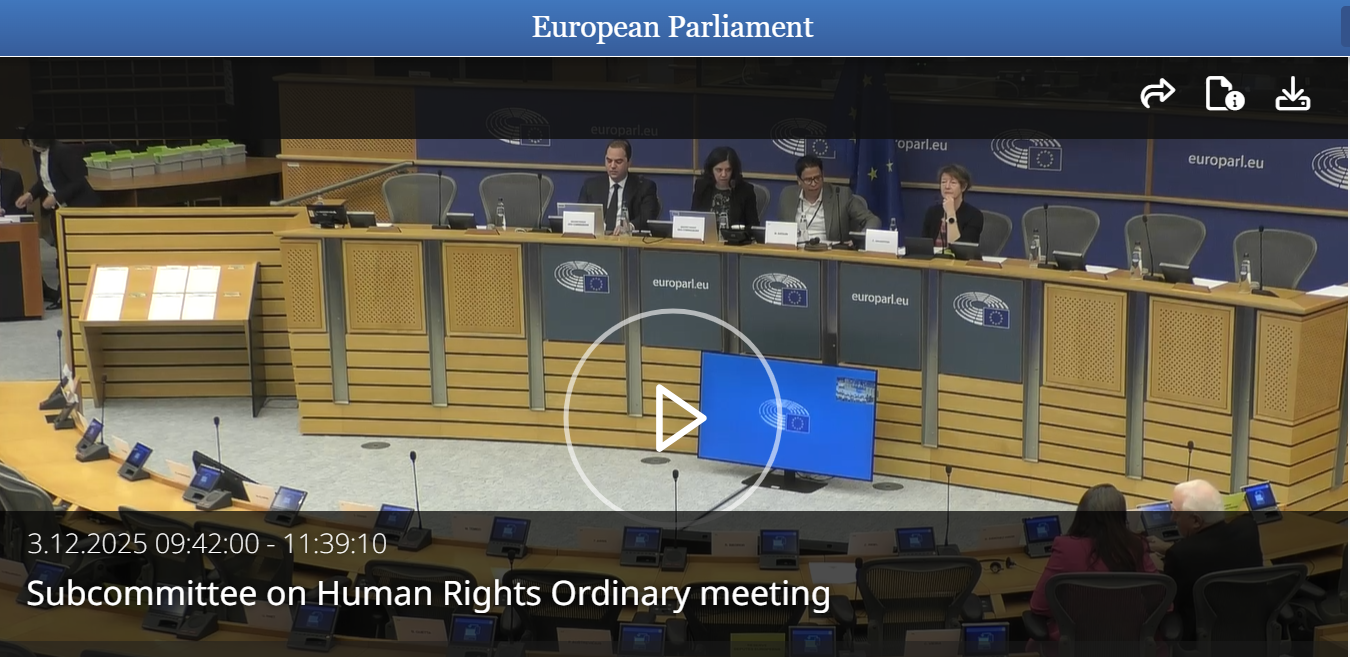
On 3 December 2025, we had the opportunity to present our work before the European Parliament’s Subcommittee on Human Rights during an exchange of views on the protection of parliamentarians at risk worldwide. The session was organized in partnership with the Committee on the Human Rights of Parliamentarians of the Inter-Parliamentary Union (IPU). It featured Senator Etienne Blanc, Chair of the IPU Committee, and Hon. Job Sikhala, MP (Zimbabwe), who testified about the political repression and arbitrary detention he endured, as well as attacks suffered by his family because of his political work.
Parliamentarians at risk: an increasing phenomenon
A decade ago, the Inter-Parliamentary Union recorded approximately 300 to 350 cases of legislators in danger through its dedicated Committee on the Human Rights of Parliamentarians, with which PGA collaborates closely. Today, this number exceeds 1,000 cases worldwide.
Such an environment threatens the ability of parliamentarians to carry out their mandate. They may lose their political rights following politically motivated prosecutions, arbitrary arrests, unfair trials, and suspensions driven by the government or parliamentary majorities. Existing disciplinary mechanisms to address misconduct by MPs often remain unused or prove ineffective.
Threats vary across regions, but they follow a global pattern:
- Weaponization of justice through politically motivated charges, arbitrary detention, and unfair proceedings.
- Digital attacks, including smear campaigns, online publication of personal information (doxing), misogynistic online harassment, and threats amplified by algorithms.
- Physical violence such as assaults, abductions, and assassinations.
- State-sponsored repression, including surveillance and suspension of parliamentary immunities.
- Growing attacks on political parties.
- Violence targeting women MPs, in all their diversities
It is important to raise awareness about the specific threats faced by women parliamentarians, who are victims of disproportionate harassment and intimidation, both online and offline, as well as gender-based and sexual violence, among other forms of physical assaults. Many of these attacks go unreported, in part because official reporting systems are often inadequate or nonexistent. This situation discourages many women from engaging in politics, a sphere where they remain underrepresented. The consequences can be devastating for a truly representative democracy.
Answering the threats: Parliamentary Rapid Response Team
The Parliamentary Rapid Response Team (PARRT) is committed to addressing the needs of parliamentarians at risk through urgent action alerts, public statements, direct or quiet advocacy, referrals to specialized civil society partner, and coordinated engagement with governments, diplomatic missions, and international partners. Parliamentarians at risk, or their colleagues, can refer cases directly to PARRT. The team then reviews the case according to rigorous criteria before deciding the appropriate action to take. This approach allows PARRT to act rapidly, responsibly, and effectively in partnership with parliamentarians.
Since its creation in 2020, the Parliamentary Rapid Response Team has intervened in a wide range of situations across regions, including the cases of Hon. Leila de Lima, MP (The Philippines), Fabien Banciryanino, MP (Burundi), Soledad Buendía, MP (Ecuador), and numerous other cases in Afghanistan, Bangladesh, Nicaragua, Sudan, Venezuela, and beyond.
This solidarity is not symbolic — it has a real impact. In several cases, international pressure has helped secure due process guarantees, obtained release from detention, or improved the safety conditions of threatened MPs.
Leadership to protect democracy
Violence against parliamentarians is part of a broader context of democratic backsliding, misogyny, disinformation ecosystems, shrinking of civic space, and normalization of authoritarian practices. To stop these attacks, institutions must address their root causes and protect the rule of law.
In this context, it is also essential to counter hate speech, which is on the rise and for which parliamentarians should be the first ones to lead by example. Parliamentarians for Global Action developed a Global Parliamentary Code of Democratic Conduct, open to signatures of all parliamentarians worldwide, to hold legislators accountable for their speech, encourage respectful and inclusive dialogue, and ensure they refrain from disseminating disinformation.
Continued leadership can protect democratic institutions. By reporting on cases of legislators at risk; strengthening international initiatives such as PARRT; and promoting early detection, rapid solidarity, and coordinated international action, parliamentarians can exercise their mandates in a safer environment, ensuring a stronger democracy.