


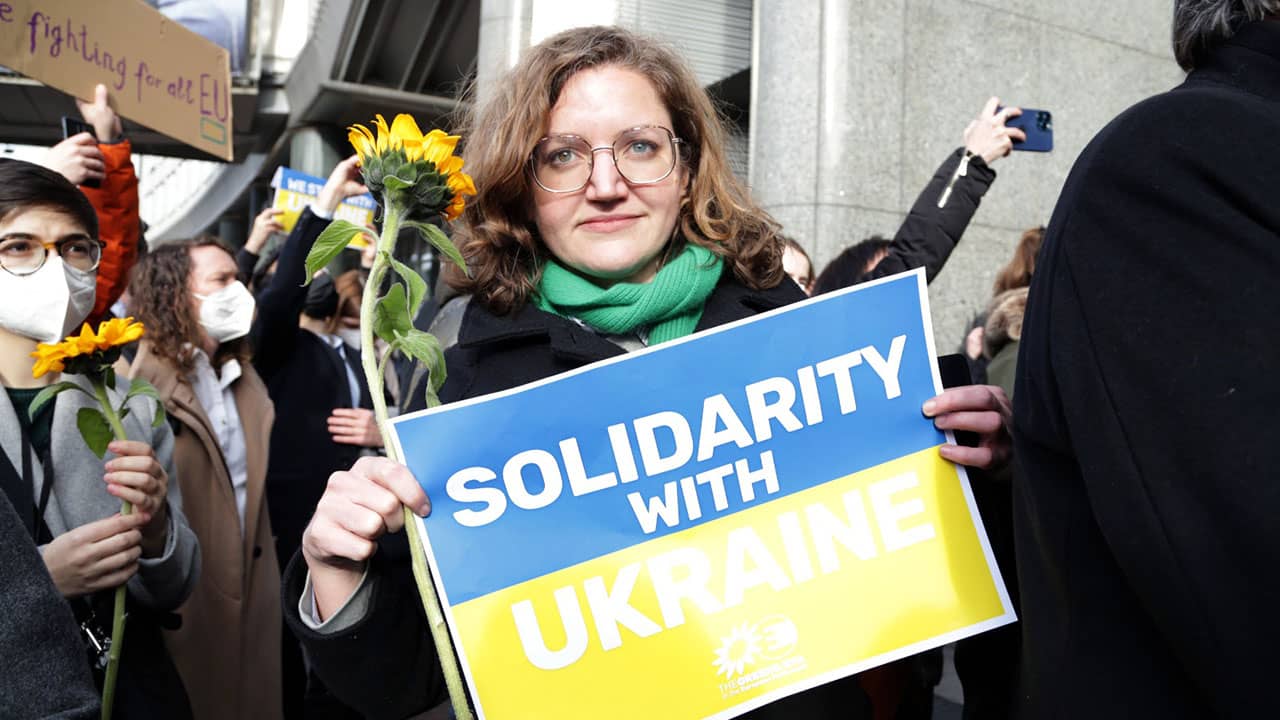
The Russian military invasion of Ukraine has passed its third month. During this time, we have witnessed appalling violations of humanitarian law, international law and the international order. This invasion has come with not only grave humanitarian consequences but also long-term environmental costs.
Since the start of the invasion, we have witnessed a range of reports on the attacks on civilian infrastructure, such as water, energy, industry and transport, some of them likely to cause widespread, long-term and severe damage to the natural environment. Many of these attacks appear to have lacked a definite military target, and may thus violate the laws of war. Academic researchers and civil society have highlighted the environmental destruction in Ukraine, as demonstrated in the joint statement to the UN Environmental Assembly and the open letter from Environmental Peacebuilding Association with co-signees. Criminal accountability for Russia’s actions is now being investigated by the Ukrainian Prosecutor, by the International Criminal Court (ICC), and multiple national prosecution offices under the principle of universal jurisdiction.
We, the members of Ecocide Alliance, an international parliamentary alliance for the recognition of ecocide, are dedicated to building peace through protecting ecosystems and biological diversity. We strongly maintain that environmental security is a precondition to ensuring national and international security.
However, pursuing individual criminal responsibility for environmental atrocities has been largely ignored and under-prosecuted at both the national and international level. For instance, the ICC Office of the Prosecutor (OTP) has never prosecuted war crimes under Article 8(2)(b)(iv) of the Rome Statute, which explicitly protects the natural environment. Nor has the OTP pursued crimes against humanity allegations in the context of mass environmental harm, relating to countries such as Cambodia or Brazil. This is, despite the fact that the OTP issued their Policy paper on case selection and prioritisation in 2016, undertaking to prioritise such cases.
Therefore, we call on the international community to: support local efforts to monitor environmental damage (e.g. Ecoaction, or other agencies); set up mechanisms to collect and share data, which could serve as evidence in potential cases concerning environmental crimes; and support organisations to analyse and build criminal cases based on such data, such as the Climate Counsel.
Ukraine is one of many countries where armed conflicts are destroying the natural environment in a severe and widespread manner. The horrific invasion of Ukraine serves as a pivotal moment when international and national institutions have the opportunity to address international crimes associated with environmental destruction.
The most effective way to enforce criminal accountability long-term, however, is to amend the Rome Statute to explicitly include ecocide as a fifth crime against peace - not limited only to war time. This would enable the ICC and national justice systems to address the most serious environmental crimes and to reduce one of the roots of conflicts, namely, the scarcity and inequitable distribution of natural resources following exploitative land-grabbing. Now, if ever, would be the time for the international community to finally draw a global moral red line concerning environmental atrocities, and put an end to impunity for ecocide.
ECOCIDE ALLIANCE MEMBERS:
- Rodrigo AGOSTINHO, deputy at the Federal Assembly (Câmara Federal), Brazil
- Alejandro AGUILERA, Deputy of the National Assembly, Venezuela
- ASEAN Parliamentarians for Human Rights
- Alexandra ATTALIDES, Member of the House of Representatives, Cyprus
- Natalie BENNETT, Member of the House of Lords, United Kingdom
- Saskia BRICMONT, Member of the European Parliament (Belgium)
- Samuel COGOLATI, Federal Deputy, Belgium
- Eufemia CULLAMAT, Member of the House of Representatives, Philippines
- Rosa D’AMATO, Member of the European Parliament (Italy)
- Eleonora EVI, Member of the European Parliament (Italy)
- Leah GAZAN, Member of Parliament, Canada
- Simon HOLMSTRÖM, member of the Åland parliament, Finland
- Andrés Ingi JÓNSSON, Member of Alþingi, Iceland
- Rebecka LE MOINE, Member of Parliament, Sweden
- Monica LENNON, Member of the Scottish Parliament, Scotland
- Caroline LUCAS, Member of the Parliament, United Kingdom
- Raphaël MAHAIM, Member of the Parliament of the canton of Vaud, Switzerland
- Elizabeth MAY, Member of Parliament, Canada
- Patrick McHEFFEY, Trustee, Patchogue, New York, USA
- Sirpa PIETIKÄINEN, Member of the European Parliament (Finland)
- Josep PUIG I BOIX, Member of the Catalan Parliament, Spain
- Janet RICE, Senator, Australia
- Caroline ROOSE, Member of the European Parliament (France)
- Inés SABANÉS, Deputy, Spain
- Lindsey SCHROMEN-WAWRIN, City Councilmember, Port Angeles, Washington State, USA
- Marie TOUSSAINT, Member of the European Parliament (France)
- Lammert VAN RAAN, Member of Parliament, Netherlands
- Larissa WATERS, Senator, Australia
- Susanne ZIMMER, Member of Parliament, Denmark